Blog

  • Clearing and Forwarding Agents: A Complete Guide for Importers & Exporters in India

    Clearing and Forwarding Agents: A Complete Guide for Importers & Exporters in India

    Introduction

    In today’s globalized trade environment, moving goods across international borders is no longer just about transportation. It involves navigating complex customs regulations, documentation, compliance requirements, and coordination across multiple stakeholders. This is where clearing and forwarding agents play a critical role.

    For businesses engaged in import and export, partnering with a reliable clearing and forwarding agent ensures smooth cargo movement, minimized delays, and full regulatory compliance. With decades of industry experience, Arrow Shipping has emerged as a trusted name in customs clearance and logistics services, supporting businesses across India with precision and professionalism.

    What Are Clearing and Forwarding Agents?

    Clearing and forwarding agents (commonly known as C&F agents) are licensed professionals who act as intermediaries between importers/exporters and customs authorities. Their primary responsibility is to ensure goods are cleared through customs efficiently and forwarded to their final destination without delays or penalties.

    Key Responsibilities of Clearing and Forwarding Agents

    • Preparation and filing of customs documentation
    • Classification of goods under correct HS codes
    • Calculation and payment of customs duties and taxes
    • Liaison with customs officials and port authorities
    • Coordination of cargo movement by air or sea
    • Ensuring compliance with import/export regulations

    By managing these complex processes, clearing and forwarding agents reduce risk, save time, and help businesses focus on their core operations.

    Arrow Shipping: Trusted Clearing and Forwarding Agents Since 1994

    With nearly three decades of experience, Arrow Shipping has built a strong reputation as dependable clearing and forwarding agents serving diverse industries.

    Strong Presence in Key Trade Hubs

    Operating from Chennai and Delhi, Arrow Shipping is strategically positioned to handle cargo through major seaports and international airports, enabling faster turnaround times for both imports and exports.

    Licensed Customs House Agent

    As an authorized Customs House Agent, Arrow Shipping is fully licensed to represent clients before Indian customs authorities, ensuring compliance, transparency, and professional accountability.


    Comprehensive Clearing and Forwarding Services by Arrow Shipping


    Import Customs Clearance

    Arrow Shipping manages complete import clearance processes, including:

    • Bill of Entry filing
    • Duty assessment and payment
    • Cargo examination coordination
    • Release of goods from customs

    Their team ensures smooth clearance across various commodity types while adhering to all regulatory norms.

    Export Customs Clearance

    For exporters, Arrow Shipping handles:

    • Shipping Bill preparation
    • Export documentation
    • Compliance with export incentives and schemes
    • Coordination with customs and port authorities

    This ensures timely shipment departures and adherence to export regulations.

    Air Freight Clearance

    Air shipments demand speed and accuracy. Arrow Shipping specializes in air freight customs clearance, ensuring urgent and high-value cargo is processed without delays.

    Sea Freight Clearance

    With extensive experience in sea freight operations, Arrow Shipping handles FCL and LCL shipments efficiently, managing port procedures and container movements seamlessly.

    End-to-End Logistics Support

    Beyond customs clearance, Arrow Shipping offers integrated logistics solutions, including cargo forwarding, coordination with shipping lines, and delivery management.


    Industries Served by Clearing and Forwarding Agents

    Clearing and forwarding agents support a wide range of industries, including:

    • Manufacturing and engineering goods
    • Pharmaceuticals and healthcare products
    • Electronics and consumer goods
    • Automotive components
    • Textiles and apparel

    Arrow Shipping’s adaptable approach allows them to tailor solutions based on industry-specific requirements.


    How to Choose the Right Clearing and Forwarding Agent

    Selecting the right partner can significantly impact your supply chain efficiency. Here’s what to look for:

    Experience and Track Record

    An established history, like Arrow Shipping’s presence since 1994, indicates reliability and deep industry knowledge.

    Geographic Coverage

    Agents with operations in key trade hubs such as Chennai and Delhi provide faster access to ports and airports.

    Range of Services

    End-to-end capabilities reduce the need to coordinate with multiple vendors, simplifying logistics management.

    Compliance and Transparency

    Licensed agents ensure ethical practices, accurate documentation, and full regulatory compliance.


    Common Challenges in Customs Clearance (and How Agents Solve Them)

    • Incorrect documentation: Prevented through expert preparation and verification
    • Regulatory changes: Managed through continuous updates and compliance checks
    • Port congestion: Mitigated by proactive planning and coordination
    • Duty disputes: Handled through proper classification and customs liaison

    Professional clearing and forwarding agents act as problem-solvers, protecting businesses from costly disruptions.


    The Future of Clearing and Forwarding in India

    With increasing digitization, evolving trade policies, and growing global commerce, the role of clearing and forwarding agents is becoming more strategic. Technology-enabled documentation, faster customs systems, and integrated logistics services are shaping the future of the industry.

    Arrow Shipping continues to adapt to these changes, combining experience with modern logistics practices to serve clients efficiently.


    Conclusion

    Clearing and forwarding agents are an indispensable part of international trade, ensuring goods move smoothly across borders while complying with complex regulations. For businesses seeking reliability, compliance, and efficiency, choosing an experienced partner makes all the difference.

    With a legacy dating back to 1994, strong operational presence in Chennai and Delhi, and expertise in air and sea shipments, Arrow Shipping stands out as a trusted clearing and forwarding agent in India.


  • CHA Customs: Complete Guide to Customs Clearance for Import and Export Businesses

    CHA Customs: Complete Guide to Customs Clearance for Import and Export Businesses

    International trade is governed by customs regulations designed to ensure legal compliance, revenue collection, and secure movement of goods across borders. For businesses involved in importing and exporting products, understanding customs procedures can be challenging. Documentation requirements, duty assessments, regulatory compliance, and cargo inspections often create complexities that require expert guidance.

    This is where CHA customs services become essential. A Customs House Agent (CHA) acts as an authorized representative who handles customs-related procedures on behalf of importers and exporters. By ensuring compliance with customs regulations and managing documentation accurately, CHA customs professionals help businesses avoid delays, penalties, and operational disruptions.

    With nearly three decades of experience, Arrow Shipping provides professional CHA customs services to support seamless international trade operations.

    What Is CHA Customs?

    CHA customs refers to the customs clearance services provided by a licensed Customs House Agent. These professionals are authorized to represent businesses before customs authorities and manage the procedures required for cargo clearance.

    The primary objective of CHA customs services is to ensure that shipments comply with all regulatory requirements before they enter or leave the country.

    Key Functions of CHA Customs Services

    • Customs documentation preparation
    • Import and export clearance
    • Duty calculation and assessment
    • Cargo examination coordination
    • Regulatory compliance management
    • Liaison with customs authorities

    CHA customs services simplify the entire clearance process for businesses involved in global trade.

    Why CHA Customs Services Are Important

    Ensuring Regulatory Compliance

    Import and export regulations are constantly evolving. Customs authorities require accurate declarations, proper documentation, and compliance with trade policies.

    CHA customs professionals ensure businesses meet all applicable requirements and avoid compliance-related issues.

    Faster Cargo Clearance

    Delays at ports and airports can result in storage charges, demurrage costs, and supply chain disruptions. Professional customs handling helps expedite clearance procedures.

    Reduced Risk of Penalties

    Incorrect classification, inaccurate declarations, or missing documentation can lead to fines and shipment holds. CHA customs experts help eliminate these risks.

    Efficient Coordination

    Customs clearance involves interaction with multiple stakeholders, including customs officials, shipping lines, airlines, and logistics providers. CHA agents coordinate these activities efficiently.

    Services Offered Under CHA Customs

    Import Customs Clearance

    Import clearance is one of the most important customs functions.

    Services include:

    • Bill of Entry filing
    • Duty assessment
    • Cargo examination support
    • Customs release coordination
    • Compliance verification

    Arrow Shipping ensures efficient import customs clearance for businesses across industries.

    Export Customs Clearance

    Exporters must comply with customs regulations before goods can leave the country.

    Export customs services include:

    • Shipping Bill filing
    • Export documentation review
    • Customs examination coordination
    • Export compliance support
    • Cargo clearance approval

    These services ensure smooth export operations and timely shipment departures.

    CHA Customs for Air Cargo

    Air cargo shipments often involve urgent deliveries and high-value goods.

    Air Customs Clearance Services

    • Air import clearance
    • Air export clearance
    • Airport customs documentation
    • Cargo release coordination
    • Airline handling support

    Arrow Shipping helps businesses achieve fast customs clearance for air freight shipments.

    CHA Customs for Sea Freight

    Sea freight remains one of the most widely used transportation methods for international trade.

    Sea Freight Customs Services

    • Container clearance
    • FCL shipment clearance
    • LCL shipment clearance
    • Port documentation processing
    • Cargo release coordination

    Professional CHA customs services ensure efficient handling of sea cargo operations.

    Essential Documents in CHA Customs Procedures

    Accurate documentation is critical for customs clearance.

    Commercial Invoice

    Provides shipment value and product details.

    Packing List

    Specifies packaging and cargo contents.

    Bill of Lading

    Required for sea freight shipments.

    Air Waybill

    Used for air cargo transportation.

    Bill of Entry

    Mandatory for import customs clearance.

    Shipping Bill

    Required for export customs processing.

    Certificate of Origin

    Confirms the country of manufacture or origin.

    Arrow Shipping ensures all customs documents are prepared accurately and submitted on time.

    Industries That Depend on CHA Customs Services

    Businesses across various industries require professional customs support.

    Manufacturing Sector

    Imports raw materials and exports finished goods.

    Automotive Industry

    Requires efficient customs handling for components and spare parts.

    Electronics Industry

    Depends on fast customs clearance for imported products.

    Pharmaceuticals

    Requires strict compliance with import and export regulations.

    Textile and Apparel

    Relies on smooth customs procedures to meet international delivery commitments.

    Arrow Shipping supports businesses across these sectors with customized customs solutions.

    Common Challenges in Customs Clearance

    Frequent Regulatory Changes

    Trade policies and customs regulations change regularly, making compliance difficult without professional guidance.

    Incorrect Product Classification

    Wrong HS code classification can result in duty disputes and penalties.

    Documentation Errors

    Missing or inaccurate information can delay cargo release.

    Cargo Inspection Delays

    Customs examinations may cause disruptions if not coordinated properly.

    Professional CHA customs services help businesses overcome these challenges efficiently.

    Why Choose Arrow Shipping for CHA Customs Services?

    Nearly 30 Years of Industry Experience

    Since 1994, Arrow Shipping has successfully handled customs clearance for a wide range of cargo types.

    Licensed Customs House Agent

    The company is authorized to represent businesses before customs authorities.

    End-to-End Logistics Support

    In addition to customs clearance, Arrow Shipping provides:

    • Freight forwarding
    • Import consultancy
    • Air freight services
    • Sea freight services
    • Bonded warehousing support

    Strategic Locations

    Operations in Chennai and Delhi provide access to key ports and airports across India.

    How CHA Customs Services Improve Supply Chain Efficiency

    Professional customs handling directly impacts supply chain performance by:

    • Reducing cargo clearance time
    • Minimizing compliance risks
    • Preventing unnecessary costs
    • Improving shipment visibility
    • Enhancing operational efficiency

    Businesses that partner with experienced customs professionals can focus on growth while ensuring smooth international trade operations.

    Future of CHA Customs Services in India

    India's logistics and customs ecosystem is evolving rapidly through digitization and infrastructure development.

    Key trends include:

    • Electronic customs filing
    • Faster cargo processing systems
    • Enhanced trade facilitation measures
    • Greater transparency in customs procedures

    As international trade volumes increase, the role of professional CHA customs services will become even more important.

    Arrow Shipping continues to adapt to these developments while maintaining high standards of compliance and customer service.

    Conclusion

    Customs clearance is one of the most critical aspects of international trade. From documentation and duty assessment to compliance and cargo release, every step requires expertise and precision.

    Professional CHA customs services help businesses navigate complex customs regulations, reduce delays, and ensure smooth import-export operations.

    With nearly three decades of experience, licensed customs expertise, and integrated logistics capabilities, Arrow Shipping remains a trusted partner for businesses seeking reliable customs clearance solutions in India.


  • Cotton Imports Now Duty-Free Until October 2026: What Importers, Textile Mills & Exporters Need to Know

    Cotton Imports Now Duty-Free Until October 2026: What Importers, Textile Mills & Exporters Need to Know

    Cotton Imports Now Duty-Free Until October 2026: What Importers, Textile Mills & Exporters Need to Know

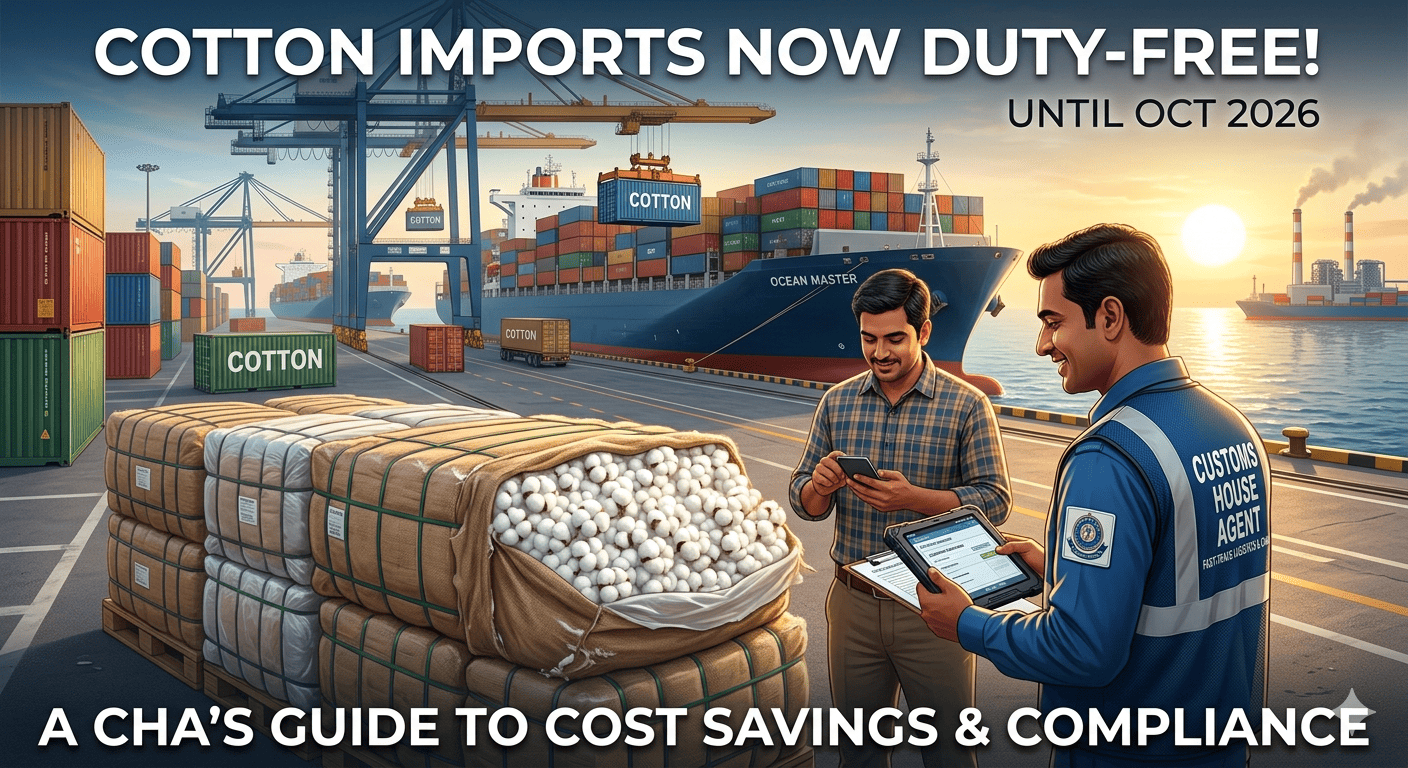
    The Government of India has announced a significant relief measure for the textile industry by exempting imported cotton from all customs duties and the Agriculture Infrastructure and Development Cess (AIDC) from June 1, 2026, to October 30, 2026.

    As a licensed Customs House Agent (CHA), we view this policy as an important trade facilitation measure aimed at ensuring uninterrupted raw material availability, reducing manufacturing costs, and improving the global competitiveness of Indian textile exporters.

    This article explains the duty exemption, its impact on importers and exporters, and the customs-related considerations businesses should keep in mind during the exemption period.


    What Has Changed?

    Prior to this notification, imported cotton attracted an effective customs duty burden of approximately 11%, comprising:

    • Basic Customs Duty (BCD)
    • Agriculture Infrastructure and Development Cess (AIDC)

    With the latest notification, both levies have been fully exempted for imports of cotton falling under the relevant tariff heading.

    Exemption Period

    Effective From: 1 June 2026

    Valid Until: 30 October 2026

    During this period, eligible cotton imports can be cleared without payment of customs duty and AIDC, subject to compliance with applicable customs regulations.


    Why Has the Government Introduced This Relief?

    The decision comes against the backdrop of increasing pressure on India's textile sector.

    Industry estimates indicate that domestic cotton production is currently insufficient to meet total consumption requirements of spinning mills, textile manufacturers, and export-oriented units.

    Several factors contributed to the government's decision:

    1. Supply-Demand Gap

    Domestic cotton production has remained below industry demand, creating concerns regarding the availability of quality raw material.

    2. Rising Cotton Prices

    Higher domestic cotton prices have increased production costs across the textile value chain, affecting the profitability of manufacturers.

    3. Export Competitiveness

    Indian textile manufacturers compete globally with countries such as Bangladesh, Vietnam, and China, where imported raw materials often enter duty-free or at lower tariff rates.

    4. Support for MSMEs

    Small and medium-sized textile units are particularly vulnerable to fluctuations in raw material prices. Lower import costs can provide immediate financial relief and support business continuity.


    Impact on Textile Manufacturers

    The duty waiver is expected to generate multiple benefits for the textile industry.

    Reduced Raw Material Costs

    Removal of the 11% duty directly lowers the landed cost of imported cotton, helping manufacturers reduce procurement expenses.

    Improved Profit Margins

    Manufacturers can benefit from lower raw material costs, resulting in better operating margins and improved financial performance.

    Better Inventory Planning

    Textile units can diversify sourcing options and maintain uninterrupted production schedules by securing cotton supplies from international markets.

    Access to Specialty Cotton

    Certain export orders require specific grades and qualities of cotton that may not always be available domestically. The exemption facilitates cost-effective imports of specialty cotton varieties.


    Impact on Exporters

    Export-oriented garment and textile manufacturers stand to benefit significantly from the duty exemption.

    Lower input costs can:

    • Improve international price competitiveness
    • Support higher export volumes
    • Enhance profitability of export contracts
    • Improve order conversion rates in global markets
    • Strengthen India's position in the global textile and apparel supply chain

    For exporters operating under strict buyer pricing structures, even a small reduction in raw material costs can create a substantial competitive advantage.


    What About Domestic Cotton Farmers?

    One of the common concerns associated with duty-free imports is the potential impact on domestic cotton growers.

    However, the government has clarified that:

    • Imports are primarily intended to bridge supply shortages.
    • Specialty cotton imports cater to specific industrial requirements.
    • Domestic procurement mechanisms remain active.
    • Minimum Support Price (MSP) protection continues through government support measures.

    The objective is not to replace domestic cotton production but to supplement available supplies during periods of shortage and high demand.


    Key Opportunities for Importers

    Businesses involved in cotton and textile imports should consider the following opportunities:

    Reviewing Procurement Strategies

    Evaluate international sourcing options and compare landed costs during the exemption period.

    Renegotiating Supply Contracts

    Lower import costs may create opportunities for more favorable purchasing arrangements with overseas suppliers.

    Building Strategic Inventory

    Importers may assess future requirements and build inventories ahead of the exemption expiry date.

    Expanding Export Opportunities

    Lower production costs can help exporters offer more competitive pricing and target new international markets.


    Our Perspective as a Licensed Customs House Agent

    As customs clearance and logistics professionals, we believe this temporary duty exemption will provide significant support to India's textile manufacturing ecosystem.

    However, importers should not view this merely as a tax-saving opportunity. Proper planning, documentation management, customs compliance, freight coordination, and timely cargo clearance will be critical to fully leveraging the benefits offered by this policy.

    Businesses intending to import cotton during the exemption period should proactively review their sourcing plans and customs documentation requirements to ensure smooth and compliant import operations.


    Conclusion

    The Government's decision to waive customs duty and AIDC on cotton imports until October 30, 2026, represents a major relief measure for India's textile and apparel industry.

    By reducing input costs and improving raw material availability, the policy is expected to support manufacturers, exporters, MSMEs, and the broader textile value chain.

    For importers, the coming months present a valuable opportunity to optimize sourcing strategies, enhance competitiveness, and strengthen supply chain resilience while taking advantage of the temporary duty exemption.

    As a trusted Customs House Agent, we continue to assist importers with customs clearance, documentation compliance, freight coordination, and end-to-end logistics support to ensure seamless cotton import operations into India.

  • Customs Broker: Your Trusted Partner for Import and Export Clearance

    Customs Broker: Your Trusted Partner for Import and Export Clearance

    Global trade offers tremendous opportunities for businesses, but it also brings challenges related to customs regulations, documentation, duties, and compliance requirements. Whether importing raw materials or exporting finished goods, companies must navigate complex customs procedures before their shipments can be released.

    This is where a customs broker becomes an essential part of the supply chain. A customs broker serves as an intermediary between businesses and customs authorities, ensuring that all import and export procedures are completed accurately and efficiently.

    By handling documentation, duty assessments, cargo examinations, and regulatory compliance, customs brokers help businesses avoid delays, reduce costs, and maintain smooth international trade operations.

    With decades of customs expertise, Arrow Shipping provides reliable customs broker services that simplify global trade for businesses across industries.

    What Is a Customs Broker?

    A customs broker is a licensed professional authorized to assist importers and exporters in clearing goods through customs. Their primary role is to ensure compliance with customs laws and facilitate the smooth movement of cargo across international borders.

    A customs broker acts on behalf of businesses to:

    • Prepare and submit customs documentation
    • Classify goods correctly
    • Calculate applicable duties and taxes
    • Coordinate with customs authorities
    • Arrange cargo examinations
    • Facilitate cargo clearance

    Customs brokers play a critical role in ensuring shipments move without unnecessary delays or penalties.

    Why Businesses Need a Customs Broker

    Navigating Complex Regulations

    Customs regulations vary by product type, country of origin, and trade agreements. A customs broker helps businesses understand and comply with these requirements.

    Faster Customs Clearance

    Accurate documentation and proper filing reduce the likelihood of shipment delays and customs queries.

    Duty and Tax Management

    Customs brokers ensure duties and taxes are calculated correctly, preventing overpayments or compliance issues.

    Risk Reduction

    Errors in customs declarations can lead to penalties, shipment holds, or legal complications. A customs broker minimizes these risks through professional oversight.

    Key Responsibilities of a Customs Broker

    A customs broker manages various aspects of import and export operations.

    Documentation Management

    Preparing and filing:

    • Bill of Entry
    • Shipping Bill
    • Commercial Invoice
    • Packing List
    • Bill of Lading
    • Air Waybill
    • Certificate of Origin

    Customs Classification

    Correct HS code classification ensures accurate duty assessment and regulatory compliance.

    Duty Assessment

    A customs broker calculates applicable customs duties, taxes, and charges to ensure proper payment.

    Customs Coordination

    Liaising with customs officials to facilitate cargo examination, inspections, and approvals.

    Cargo Release

    Ensuring shipments are released quickly after customs clearance.

    Customs Broker Services for Importers

    Importing goods into India requires adherence to customs procedures and regulations.

    Import Customs Clearance

    A customs broker handles:

    • Bill of Entry filing
    • Import documentation review
    • Duty assessment
    • Cargo examination coordination
    • Clearance approval

    These services ensure imported goods are released efficiently.

    Import Compliance Advisory

    Customs brokers help businesses understand:

    • Import restrictions
    • Product-specific regulations
    • Licensing requirements
    • Duty implications

    This guidance helps avoid costly mistakes.

    Customs Broker Services for Exporters

    Export operations also require professional customs support.

    Export Documentation

    A customs broker prepares and verifies export documents required by customs authorities.

    Shipping Bill Processing

    Accurate filing ensures smooth customs approval for export shipments.

    Regulatory Compliance

    Customs brokers ensure exporters comply with applicable trade regulations and customs requirements.

    Cargo Clearance

    Professional handling reduces delays and ensures timely shipment departures.

    Customs Broker Services for Air Freight

    Air freight shipments require rapid processing and customs coordination.

    Air Import Clearance

    Fast customs clearance for incoming air cargo.

    Air Export Clearance

    Timely documentation and approvals for outbound shipments.

    Airport Customs Coordination

    Managing cargo examinations and customs procedures at airports.

    Arrow Shipping ensures efficient customs support for air freight operations.

    Customs Broker Services for Sea Freight

    Sea freight remains one of the most widely used transportation methods for international trade.

    Container Clearance

    Managing customs procedures for containerized cargo.

    FCL and LCL Shipments

    Handling both Full Container Load and Less than Container Load clearances.

    Port Documentation

    Ensuring all customs and port-related paperwork is completed accurately.

    Cargo Release

    Facilitating smooth movement of cargo from ports to final destinations.

    Industries That Depend on Customs Brokers

    Customs broker services are essential across multiple sectors.

    Manufacturing

    Importing raw materials and exporting finished products.

    Automotive

    Managing customs clearance for components and spare parts.

    Electronics

    Handling high-value imported products and components.

    Pharmaceuticals

    Ensuring compliance with strict import and export regulations.

    Textiles

    Supporting international trade through efficient customs procedures.

    Arrow Shipping serves businesses across these industries with customized customs solutions.

    Common Challenges in Customs Clearance

    Documentation Errors

    Incomplete or incorrect documents can delay shipments.

    Regulatory Changes

    Customs policies and trade regulations change frequently.

    Product Classification Issues

    Incorrect HS codes can lead to duty disputes and penalties.

    Cargo Inspections

    Unexpected inspections may impact delivery schedules.

    Professional customs broker services help businesses overcome these challenges effectively.

    Why Choose Arrow Shipping as Your Customs Broker?

    Nearly Three Decades of Experience

    Since 1994, Arrow Shipping has successfully handled customs clearance for a wide range of industries.

    Licensed Customs Expertise

    The company has extensive knowledge of customs procedures and regulatory requirements.

    Integrated Logistics Solutions

    Arrow Shipping offers:

    • Customs clearance
    • Freight forwarding
    • Import consultancy
    • Air freight services
    • Sea freight services
    • Bonded warehousing support

    Strategic Presence

    Operations in Chennai and Delhi provide access to key ports and airports across India.

    How a Customs Broker Improves Supply Chain Efficiency

    Working with a professional customs broker provides several benefits:

    • Faster cargo clearance
    • Improved compliance
    • Reduced logistics delays
    • Better cost control
    • Enhanced shipment visibility
    • Lower risk of penalties

    These advantages contribute to a more efficient and reliable supply chain.

    Future of Customs Broker Services in India

    India's trade and logistics sector is rapidly evolving through digitization and trade facilitation initiatives.

    Emerging trends include:

    • Electronic customs documentation
    • Automated clearance processes
    • Enhanced compliance systems
    • Faster cargo processing

    As international trade continues to grow, customs brokers will play an increasingly important role in supporting businesses.

    Arrow Shipping remains committed to providing modern customs solutions while maintaining high standards of service and compliance.

    Conclusion

    A professional customs broker is an invaluable partner for businesses engaged in international trade. From documentation and compliance to duty assessment and cargo clearance, customs brokers simplify complex customs procedures and help businesses operate efficiently.

    With nearly 30 years of experience, comprehensive customs expertise, and integrated logistics capabilities, Arrow Shipping provides dependable customs broker services for importers and exporters across India.

  • Custom Clearance in India: Complete Guide for Importers & Exporters (2026)

    Custom Clearance in India: Complete Guide for Importers & Exporters (2026)


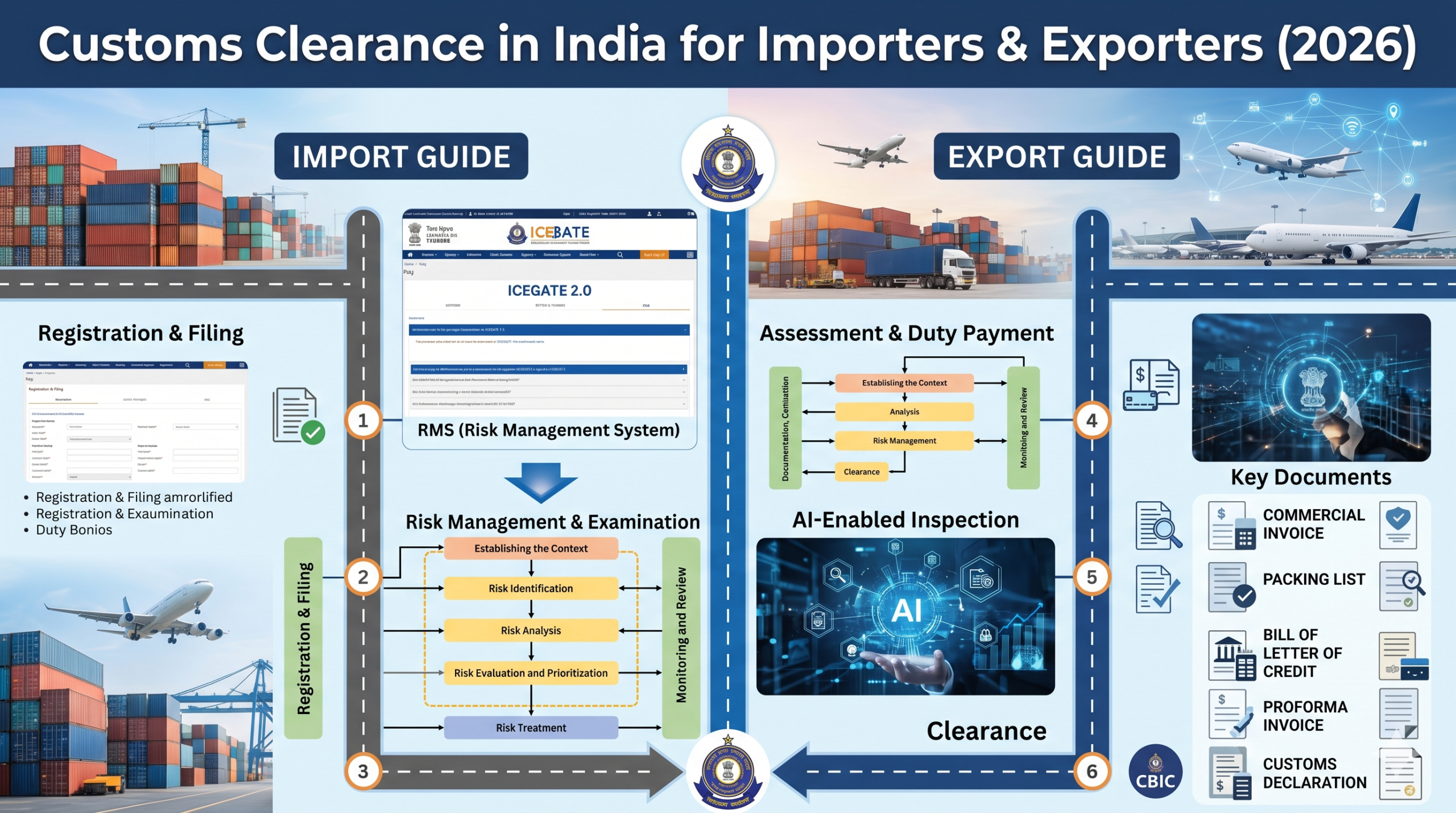
    Custom clearance in India is the mandatory process of declaring goods to Indian Customs, paying applicable duties, and obtaining release for import or export. It involves filing a Bill of Entry (import) or Shipping Bill (export) on ICEGATE, duty payment, and possible examination. Green channel cargo clears in 1–2 days. A licensed Customs House Agent (CHA) manages the full process on your behalf, reducing delays and ensuring compliance.

    Every shipment that crosses India's borders must pass through customs. Whether you're importing raw materials, machinery, or finished goods — or exporting products to global markets — customs clearance is the regulatory gateway that decides how fast and how smoothly your cargo moves.

    Get it right, and your goods are released within days. Get it wrong, and you're looking at demurrage charges, compliance penalties, and supply chain disruption. The rules are detailed, the documentation is strict, and the process changes frequently.

    This guide breaks down exactly how custom clearance works in India — from filing your first Bill of Entry to collecting your cargo after the Out-of-Charge order. We cover every step, every document, and every common mistake that causes avoidable delays.

    What is custom clearance in India? Custom clearance is the official process of submitting an import or export declaration to Indian Customs, paying all applicable duties and taxes, and receiving authorisation to release the cargo. It is governed by the Customs Act 1962 and administered by CBIC through the ICEGATE digital portal. Most standard import clearances take 1–5 working days depending on the risk channel assigned to the shipment.

    Key Custom Clearance Statistics — India 2026

    Metric Data Point Source
    Green Channel clearance time 1–2 working days CBIC
    Yellow Channel clearance time 2–5 working days CBIC
    Red Channel clearance time 5–10 working days CBIC
    Total ports & ICDs in India 212+ CBIC Port Directory
    India merchandise exports 2024–25 USD 437 billion Ministry of Commerce 2025
    Basic Customs Duty range 0%–150% Customs Tariff Act
    IGST on imports 5%–28% GST Council
    AEO-certified entities in India 5,500+ (2025) CBIC Annual Report 2025
    Demurrage cost at Chennai Port INR 5,000–25,000/container/day Chennai Port Trust
    ICEGATE daily Bill of Entry filings 1.5 lakh+ ICEGATE Portal Data
    Arrow Shipping experience 30+ years since 1994 Arrow Shipping
    Ports covered by Arrow Shipping All major Indian seaports & airports Arrow Shipping

    What Is Custom Clearance in India?

    Custom clearance is the formal regulatory process that every commercial shipment must complete before it can enter or leave India. When goods arrive at an Indian port or airport, they're held in a customs area until the importer files the required declaration, pays applicable duties, and receives official clearance from the customs authority.

    The process is administered by the Central Board of Indirect Taxes and Customs (CBIC) under the Customs Act 1962. All filings go through the ICEGATE portal — India's national customs electronic gateway. ICEGATE handles everything from Bill of Entry filing and duty calculation to risk assessment and cargo release orders.

    Custom clearance applies to both imports and exports, though the documents and procedures differ. Imports involve a Bill of Entry; exports require a Shipping Bill. Both require accurate commodity classification using India's ITC-HS code system, which determines the duty rate applicable to your goods.

    The Custom Clearance Process in India — Step by Step

    Whether you import via sea or air, the customs clearance sequence follows a defined path. Understanding each step helps you prepare the right documents, anticipate timelines, and avoid the most common delays.

    Step 1: Document Collection

    Before any customs filing begins, your CHA needs the full document set. For sea imports, this includes the Bill of Lading, commercial invoice, packing list, and certificate of origin. Air imports use an Air Waybill instead of a Bill of Lading. Commodity-specific licences — such as those required for electronics, chemicals, or medical equipment — must also be ready at this stage.

    Step 2: Bill of Entry Filing on ICEGATE

    Your licensed CHA files the Bill of Entry electronically on ICEGATE. This document declares the goods, their assessed value, the applicable ITC-HS code, and the duty payable. Accuracy matters here — incorrect HS classification or undervaluation triggers re-assessment, examination, or penalties. A good CHA gets this right the first time.

    Step 3: Risk Channel Assessment

    ICEGATE's risk management system automatically assigns your shipment to one of three channels after the Bill of Entry is filed. Green channel — fastest clearance, no examination needed. Yellow channel — document verification only. Red channel — physical examination of goods by customs officers. AEO-certified importers are more likely to land in the green channel.

    Step 4: Duty Payment

    Once the Bill of Entry is assessed and duties are calculated, you pay electronically through the ICEGATE payment gateway. Duties typically include Basic Customs Duty (BCD), Integrated GST (IGST), and in some cases Social Welfare Surcharge or other applicable cess. Your CHA will confirm the exact duty amount before payment.

    Step 5: Examination (Yellow and Red Channel)

    For yellow and red channel shipments, customs officers verify documents or physically examine the cargo. This can add 2–7 days to the clearance timeline. Good documentation and accurate pre-filing significantly reduce the chance of being assigned to these channels.

    Step 6: Out-of-Charge Order and Cargo Release

    Once duties are paid and any examination is complete, Indian Customs issues an Out-of-Charge order. This authorises the port or airline to release the cargo. Your CHA then coordinates with the port, the shipping line or airline, and your transporter to arrange final delivery.

    Quick answer — How long does customs clearance take? Green channel: 1–2 days. Yellow channel: 2–5 days. Red channel: 5–10 days. AEO importers typically clear faster across all channels. Delays happen when documents are incomplete, HS codes are wrong, or duty payment is delayed.

    Documents Required for Customs Clearance in India

    Incorrect or incomplete documentation is the single biggest cause of customs delays. Here's the standard document set for imports and exports:

    Import Clearance Documents

    • Bill of Entry — filed by your CHA on ICEGATE
    • Commercial Invoice — shows the transaction value of goods
    • Packing List — itemises contents, weights, and dimensions
    • Bill of Lading (sea) or Air Waybill (air) — transport document
    • Certificate of Origin — required for preferential duty claims under trade agreements
    • Import Licence — for restricted or canalized goods
    • Test Reports or FSSAI Approval — for food, pharma, or regulated products

    Export Clearance Documents

    • Shipping Bill — filed on ICEGATE by your CHA
    • Commercial Invoice and Packing List
    • Export Licence — for restricted export items under DGFT policy
    • ARE-1 Form — for exports under rebate of central excise
    • Certificate of Origin — for preferential market access

    How Customs Duty Is Calculated in India

    Understanding your duty liability before the cargo arrives saves surprises and helps with cost planning. Customs duty in India is not a single flat rate — it's a combination of several components stacked on each other.

    Components of Customs Duty

    Duty Component Description Typical Rate
    Basic Customs Duty (BCD) Primary duty on imported goods 0%–150% by HS code
    Integrated GST (IGST) GST levied on imports 5%, 12%, 18%, or 28%
    Social Welfare Surcharge (SWS) 10% of BCD 10% on BCD amount
    Countervailing Duty (CVD) Applied on subsidised imports Commodity-specific
    Anti-Dumping Duty (ADD) On goods dumped below fair value Commodity and origin specific

    The total duty is calculated on the CIF value (Cost + Insurance + Freight) of the goods, not just the invoice value. This is an important distinction — your CHA will calculate the assessable value accurately before filing.

    Can IGST paid on imports be claimed as input tax credit? Yes. IGST paid at the time of customs clearance can be claimed as input tax credit (ITC) under GST rules, provided the goods are used for business purposes. This effectively reduces the net duty cost for registered GST businesses.

    AEO Certification and Its Impact on Clearance Speed

    The Authorised Economic Operator (AEO) programme is CBIC's trusted trader initiative. Businesses that meet strict compliance, financial, and security standards can apply for AEO certification and enjoy significant clearance advantages.

    AEO importers get priority processing, higher probability of green channel assignment, reduced examination frequency, and deferred duty payment benefits. For high-volume importers, AEO status translates directly into lower demurrage costs and faster supply chain cycles.

    Arrow Shipping is AEO-certified. This means shipments we handle benefit from our certification status, our strong compliance record, and our established working relationships with customs officers at Chennai and other major ports.

    Common Causes of Customs Clearance Delays

    Most delays in Indian customs clearance trace back to a handful of predictable problems. Knowing them in advance lets you avoid them entirely.

    • Wrong HS code classification — triggers reassessment, disputes, and sometimes seizure
    • Undervaluation of goods — customs often applies transaction value scrutiny
    • Missing or inconsistent documents — invoice and packing list must match exactly
    • Delayed duty payment — goods sit in the port warehouse, accruing demurrage
    • Restricted or prohibited goods — items needing licences that weren't obtained in advance
    • Mismatch between cargo description and Bill of Entry — leads to red channel assignment

    Warning — Demurrage Adds Up Fast: Chennai Port charges demurrage from day one after the free period ends. A 40-foot container sitting uncleared for 10 extra days can cost INR 1–2.5 lakh in port charges alone — before you count storage or shipping line fees. Fast, accurate filing prevents this entirely.

    How a Customs House Agent Makes the Difference

    A Customs House Agent is more than a document filer. A good CHA is your compliance partner — someone who knows the tariff schedule, understands customs officer expectations, and can navigate problems before they become delays.

    At Arrow Shipping, our CHA team has handled customs clearance across every major Indian port since 1994. We know Chennai Customs, JNPT, Mumbai Air Cargo, and every port's specific procedures. Our clients don't worry about HS codes, duty disputes, or examination outcomes — we manage that entirely.

    Internal links for reference:

    10-Point Customs Clearance Readiness Checklist

    Use this checklist before your next shipment arrives at an Indian port or airport:

    • ? Commercial invoice prepared with correct declared value (CIF basis)
    • ? Packing list matches invoice line-by-line
    • ? Bill of Lading or Air Waybill received from carrier
    • ? Correct ITC-HS code confirmed with your CHA
    • ? Certificate of Origin obtained (for preferential duty)
    • ? Import licence or permit in hand (for regulated goods)
    • ? FSSAI / BIS / other regulatory approval ready (if applicable)
    • ? Funds ready for duty payment before cargo arrives
    • ? CHA appointed and documents shared 48 hours before arrival
    • ? Transport and delivery plan confirmed to avoid port storage charges

    Frequently Asked Questions — Custom Clearance India

    What is custom clearance in India?

    Custom clearance is the official process of declaring imported or exported goods to Indian Customs, paying applicable duties, and obtaining authorisation for cargo release. It is governed by the Customs Act 1962, administered by CBIC, and executed electronically through the ICEGATE portal. Standard clearance takes 1–5 working days depending on the risk channel assigned.

    What documents are required for customs clearance in India?

    For imports: Bill of Entry, commercial invoice, packing list, Bill of Lading or Air Waybill, and certificate of origin. For exports: Shipping Bill, commercial invoice, packing list, and export licence if applicable. Regulated goods require additional approvals from FSSAI, BIS, DGFT, or other authorities depending on the commodity.

    How long does customs clearance take in India?

    Green channel cargo clears in 1–2 working days; yellow channel in 2–5 days; red channel in 5–10 days. AEO-certified importers receive priority processing and are more likely to be assigned to faster channels. Delays from incomplete documents or duty payment issues can extend this significantly.

    What is a Customs House Agent (CHA)?

    A CHA is a CBIC-licensed professional authorised to file customs declarations and manage the clearance process on behalf of importers and exporters. They handle Bill of Entry filing, HS code classification, duty assessment, examination coordination, and cargo release. Using a licensed CHA is mandatory for commercial shipments at Indian ports.

    What are the three customs clearance channels in India?

    Green channel: direct clearance without examination. Yellow channel: document verification only. Red channel: physical examination of goods. Channel assignment is done automatically by ICEGATE's risk management system based on the cargo type, declared value, importer history, and compliance record.

    How is customs duty calculated in India?

    Customs duty is calculated on the CIF value (Cost + Insurance + Freight) of the goods. The total charge includes Basic Customs Duty, IGST (5%–28%), and Social Welfare Surcharge. The applicable rate depends on the ITC-HS code of the commodity. IGST paid on imports can be claimed as input tax credit by GST-registered businesses.

    What happens if customs clearance is delayed?

    Delayed clearance triggers demurrage charges from the port and the shipping line, which escalate daily. At Chennai Port, demurrage can reach INR 5,000–25,000 per container per day after the free period ends. Additionally, prolonged port storage increases cargo damage risk. Engaging an experienced CHA and filing complete documents before arrival prevents most delays.

    How does Arrow Shipping handle custom clearance?

    Arrow Shipping manages every step of the customs clearance process — from document collection and HS classification to ICEGATE filing, duty payment, examination coordination, and cargo release. As an AEO-certified CHA with 30+ years of experience at Chennai and all major Indian ports, we ensure fast, compliant clearance with minimal demurrage exposure for our clients.

    Related Resources

  • Air and Sea Freight Forwarding in India: Complete Guide for Importers & Exporters (2026)

    Air and Sea Freight Forwarding in India: Complete Guide for Importers & Exporters (2026)

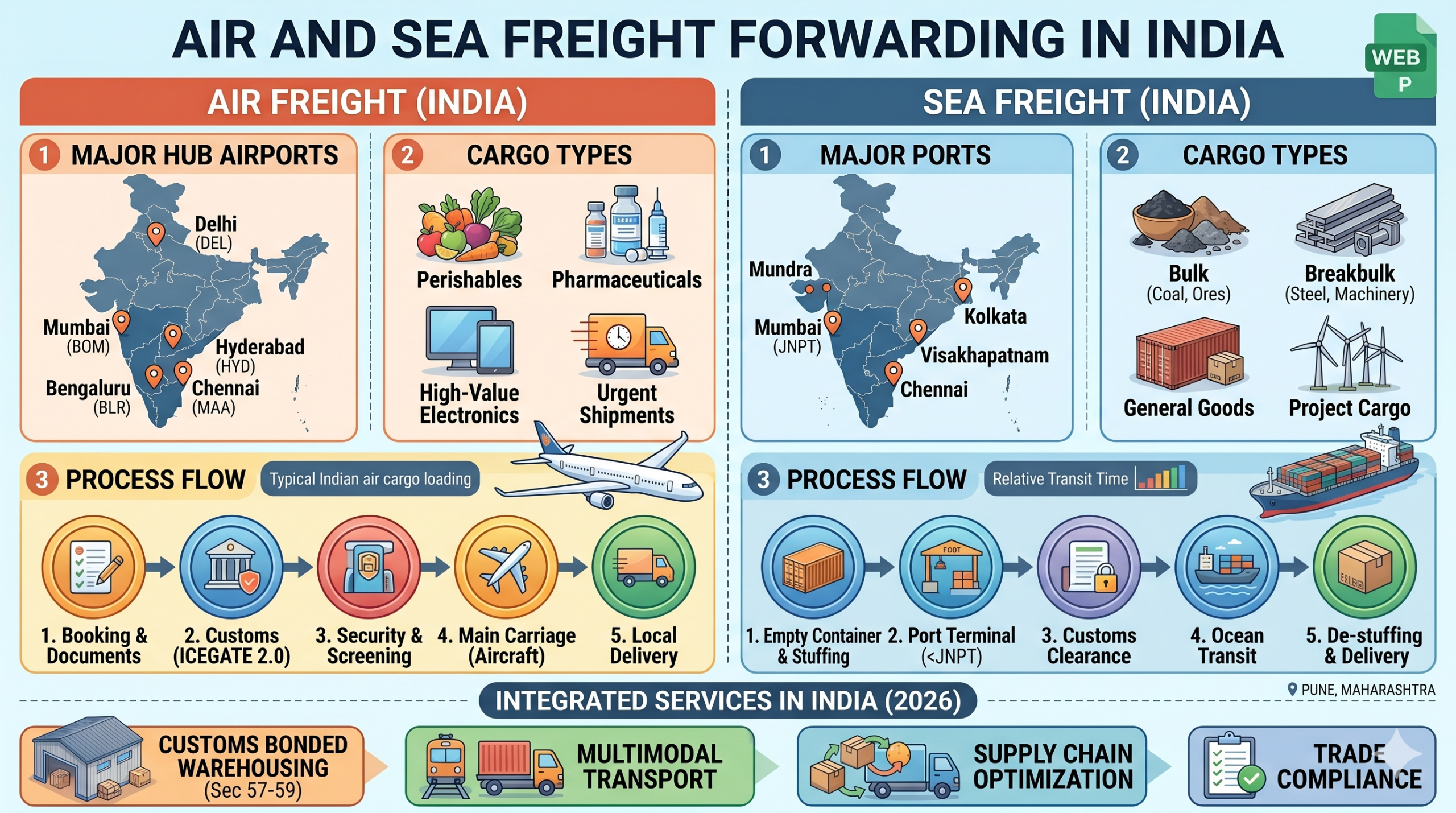
    Freight forwarding in India means organising international cargo movement via air or sea on behalf of importers and exporters. A freight forwarder books cargo space, manages documentation, and coordinates customs clearance. Air freight is fast (1–5 days) but expensive. Sea freight is slower (10–35 days) but far more cost-effective for volume. Choosing the right mode — and the right forwarder — determines your total landed cost and supply chain reliability.

    Getting cargo across borders isn't just about booking a ship or a plane. It's about understanding which mode fits your timeline and budget, choosing the right container type, structuring the trade terms correctly, and making sure customs at both ends doesn't hold things up.

    That's what a freight forwarder does. They manage the logistics chain between your factory and your buyer's door — or between your supplier's warehouse and yours — so you can focus on running your business.

    This guide explains how freight forwarding works in India, what air and sea freight each offer, how FCL and LCL differ, why Incoterms matter, and what to look for when choosing a freight forwarding partner.

    What is freight forwarding in India? Freight forwarding is the service of organising international cargo shipments for importers and exporters. A licensed freight forwarder books cargo space with airlines or shipping lines, prepares and files shipping documents, manages customs clearance, and coordinates final delivery. They act as the single point of contact between your business and the carriers, ports, and customs authorities involved in your shipment.

    Freight Forwarding India — Key Facts & Benchmarks 2026

    Metric Data Point Source
    India merchandise exports 2024–25 USD 437 billion Ministry of Commerce 2025
    Air freight transit time (India to key markets) 1–5 days Industry benchmark
    Sea freight — China to Chennai (FCL direct) 12–18 days Carrier schedules
    Sea vs air freight cost differential Sea is 4–6x cheaper per kg Industry benchmark
    20-foot container capacity ~25 tonnes / 25 CBM ISO Standard
    40-foot container capacity ~28 tonnes / 60 CBM ISO Standard
    Chennai Port annual throughput 2 million+ TEUs/year Chennai Port Authority
    Arrow Shipping freight experience 30+ years since 1994 Arrow Shipping
    Arrow Shipping AEO status Certified by Indian Customs CBIC

    What Does a Freight Forwarder Actually Do?

    A freight forwarder is not a carrier. They don't own ships or planes. What they own is expertise, relationships, and a network — and they use all three to move your cargo efficiently and compliantly across international borders.

    Here's what a full-service freight forwarder manages for you:

    • Carrier booking — securing space on the right vessel or aircraft at the right rate
    • Document preparation — Bill of Lading, Air Waybill, Shipping Bill, commercial invoice review
    • Customs coordination — working with CHAs to file clearance documents at origin and destination
    • Cargo tracking — monitoring shipment status and flagging issues proactively
    • Insurance advisory — recommending appropriate marine or air cargo insurance
    • Last-mile delivery coordination — arranging port-to-warehouse or port-to-factory transport

    At Arrow Shipping, we are both a licensed freight forwarder and a licensed Customs House Agent. This means customs clearance and freight are managed by the same team — no gaps, no hand-off delays, no coordination gaps between separate providers.

    Air Freight vs Sea Freight — Which Is Right for Your Shipment?

    The choice between air and sea freight comes down to four variables: time, cost, volume, and cargo type. Neither is universally better — the right answer depends on your specific shipment.

    Factor Air Freight Sea Freight
    Transit time 1–5 days internationally 10–35 days depending on route
    Cost per kg High — 4–6x more than sea Low — best for volume
    Best for Urgent, high-value, perishable Bulk, heavy, price-sensitive
    Weight limit per shipment No formal limit but cost rises fast Up to 28 tonnes (40-ft FCL)
    Frequency Daily flights on major routes Weekly or bi-weekly vessel calls
    Size restrictions Strict — aircraft hold dimensions Flexible — OOG options available
    Carbon footprint Higher per tonne-km Lower per tonne-km

    When should you choose air freight over sea? Air freight makes sense when your cargo is time-critical (product launches, spare parts, emergency restocking), when the goods are high-value relative to their weight (electronics, pharmaceuticals, precious materials), or when the cost of delay exceeds the premium cost of air. For routine bulk imports, sea freight almost always wins on total landed cost.

    FCL vs LCL — Full Container vs Shared Container

    For sea freight, the choice between FCL and LCL is one of the most commercially important decisions in your freight plan.

    Full Container Load (FCL)

    You book an entire container — either a 20-foot (20 TEU) or 40-foot (40 TEU) — for your cargo alone. The container goes from your supplier's factory to your destination without being opened or mixed with other cargo. FCL offers better transit times, lower handling risk, and lower cost per unit for large volumes. If your cargo fills more than 15 CBM, FCL usually beats LCL on cost.

    Less than Container Load (LCL)

    Your cargo shares container space with other shippers' goods. You pay only for the cubic metres or tonnage your cargo occupies. LCL is cost-effective for smaller shipments — typically under 10–12 CBM. The tradeoff is slightly longer transit time (cargo is consolidated at origin and deconsolidated at destination) and higher per-unit handling risk.

    Incoterms — Who Pays for What?

    Incoterms (International Commercial Terms) define exactly where seller responsibility ends and buyer responsibility begins. Getting this wrong creates unexpected costs and uncovered risk. Here are the most common Incoterms used in India trade:

    Incoterm What Seller Covers What Buyer Covers
    EXW (Ex Works) Goods ready at factory Everything from factory gate
    FOB (Free on Board) To port + load on vessel Freight + insurance + destination
    CIF (Cost, Insurance & Freight) Freight + insurance to destination port Import duties + local delivery
    DDP (Delivered Duty Paid) Everything including import duty Nothing — seller handles all
    DAP (Delivered at Place) Delivery to named destination Import duties + unloading

    Most Indian importers use FOB or CIF terms. Which is better? FOB gives you control over freight — you choose your forwarder and negotiate your own rates. CIF transfers freight control to the seller. FOB is generally preferred by experienced importers because it gives visibility and control over total freight cost. Always consult your freight forwarder on which Incoterm gives you the best cost position for your specific trade lane.

    The Freight Forwarding Process — Step by Step

    Here's how a typical sea freight import through Arrow Shipping moves from supplier booking to Chennai delivery:

    1. Freight quotation — Supplier provides cargo details; we compare carrier rates and recommend the best option
    2. Container booking — We book FCL or LCL space with the shipping line on your behalf
    3. Document coordination — We collect Bill of Lading, commercial invoice, packing list, and certificate of origin from your supplier
    4. Customs filing — Our CHA team files the Bill of Entry on ICEGATE before the vessel arrives
    5. Duty payment and clearance — Duties paid electronically; clearance obtained in 1–5 days depending on channel
    6. Port pickup and delivery — Container released from port; transported to your factory or our bonded warehouse

    Special Cargo — Project and OOG Shipments

    Not everything fits in a standard container. Machinery, industrial equipment, structural steel, and large infrastructure components often require out-of-gauge (OOG) or project cargo handling — flat-rack containers, open-top containers, heavy-lift vessels, or multi-modal logistics plans.

    Arrow Shipping has handled project cargo for clients across manufacturing, infrastructure, and energy sectors. We coordinate specialist carriers, port authorities, and inland transport to move heavy and oversized shipments without disruption.

    See our Project Cargo services page for details.

    How to Choose the Right Freight Forwarder in India

    The freight market has many providers. The difference between them shows in how they handle problems — a missed vessel call, a customs query, a document discrepancy at 11 PM before sailing day. Here's what to evaluate:

    • Licensing and compliance — Freight forwarder should be a licensed CHA or work closely with one. AEO certification is a strong indicator of compliance standards.
    • Trade lane expertise — Experience on your specific origin-destination route matters. Chennai-China, Chennai-Europe, and Chennai-USA each have different carrier options, transit times, and port procedures.
    • In-house customs capability — Forwarders who also handle customs clearance eliminate hand-off risk. When one team manages freight and clearance, nothing falls between the cracks.
    • Transparency on pricing — Freight quotes should itemise every charge: ocean freight, origin charges, destination charges, CFS handling, customs fees. Hidden charges are a red flag.
    • Track record and references — Ask for client references in your industry. Experienced forwarders have documented case histories and established relationships with port authorities.

    Arrow Shipping checks every one of these boxes — 30+ years of freight experience, AEO certification, in-house CHA team, and a client list that includes global manufacturers, pharma companies, and engineering firms importing through Chennai.

    10-Point Freight Forwarding Readiness Checklist

    • ? Incoterm agreed with supplier or buyer — and both parties understand its implications
    • ? Cargo dimensions, weight, and CBM confirmed before freight quote
    • ? FCL vs LCL decision made based on volume threshold (typically 12–15 CBM)
    • ? Air vs sea mode selected based on timeline and cost analysis
    • ? Freight forwarder appointed with CHA capability included
    • ? Commercial invoice and packing list prepared accurately before container stuffing
    • ? Bill of Lading or Air Waybill received and checked for accuracy before vessel/flight
    • ? Customs duty estimate obtained before cargo arrives at Indian port
    • ? Marine cargo insurance arranged for the shipment
    • ? Delivery plan from port to factory or warehouse confirmed in advance

    Frequently Asked Questions — Freight Forwarding India

    What is freight forwarding in India?

    Freight forwarding is the service of organising international cargo shipments for Indian importers and exporters. A freight forwarder books cargo space with airlines or shipping lines, prepares shipping documents, coordinates customs clearance, and manages end-to-end cargo delivery. They are the logistics intermediary between your business and the carriers, ports, and customs authorities involved in your shipment.

    What is the difference between air freight and sea freight?

    Air freight is fast (1–5 days) but expensive — 4–6 times more per kg than sea freight for equivalent volume. Sea freight is slower (10–35 days) but significantly cheaper for bulk cargo. Air freight suits urgent, high-value, or lightweight shipments. Sea freight is the standard for most industrial imports and bulk commodity trade.

    What is FCL vs LCL in sea freight?

    FCL is a Full Container Load — you book the entire container. LCL is Less than Container Load — your cargo shares space with other shippers. FCL is more cost-effective for volumes above 12–15 CBM and offers better transit time. LCL suits smaller shipments where paying for an entire container is not economical.

    How long does sea freight from China to Chennai take?

    FCL direct services from major Chinese ports (Shanghai, Guangzhou, Ningbo) to Chennai take 12–18 days. LCL and transshipment routes via Singapore or Colombo add 7–14 days to the total transit time. Exact schedules depend on carrier, vessel, and origin port selection.

    What are Incoterms and why do they matter?

    Incoterms are standardised trade terms that define who — buyer or seller — bears the cost and risk of shipping at each stage of the journey. Common terms include FOB, CIF, EXW, DDP, and DAP. Choosing the wrong Incoterm can leave you responsible for freight costs or risks you didn't anticipate, so it's essential to agree on and understand terms before placing the order.

    Why choose Arrow Shipping as a freight forwarder?

    Arrow Shipping combines 30+ years of freight forwarding experience with AEO certification and in-house CHA capability at Chennai and all major Indian ports. We manage air freight, sea freight (FCL and LCL), project cargo, customs clearance, and bonded warehousing under one roof — giving clients a single point of contact and full visibility across their entire import or export chain.

    Related Resources

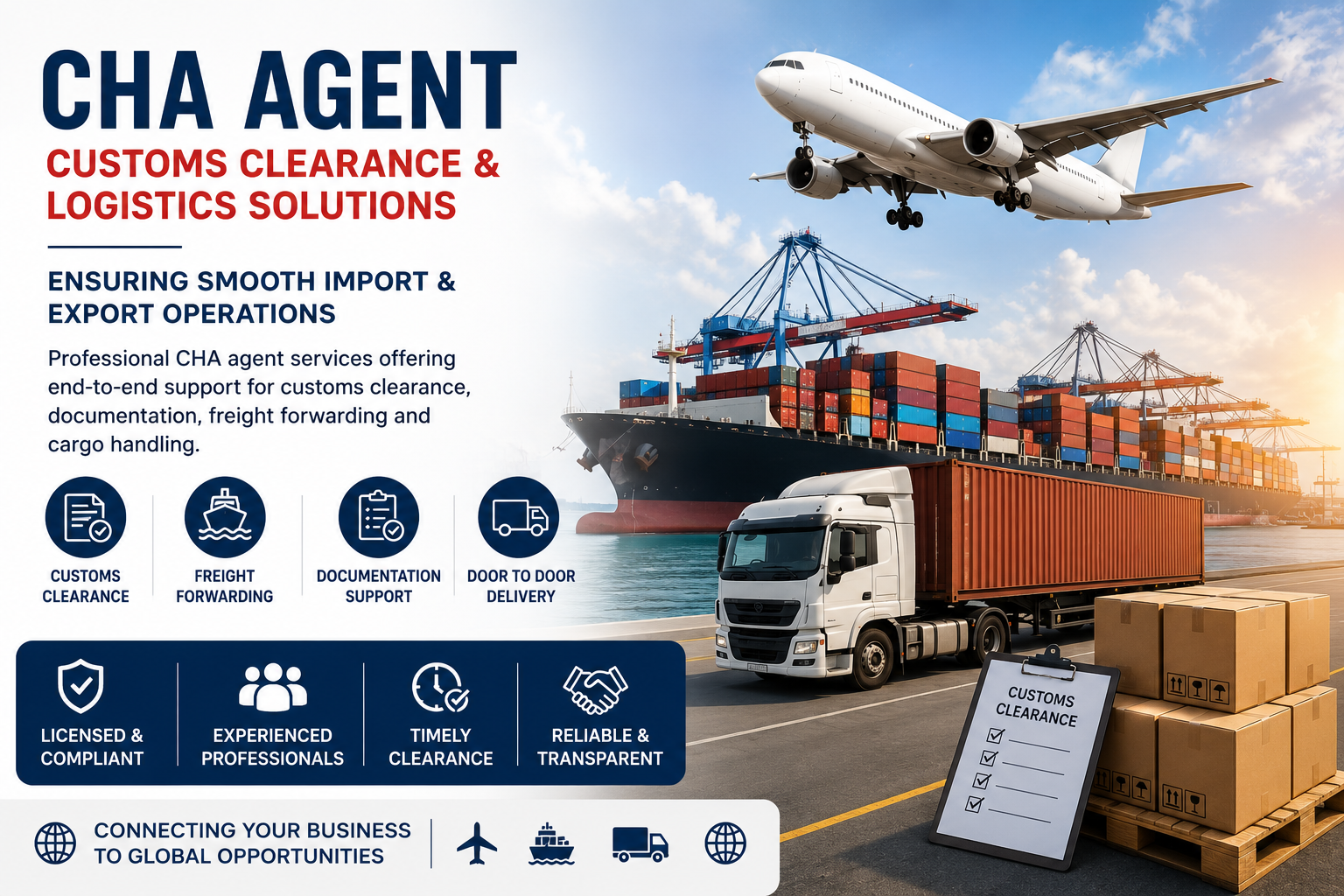
  • CHA Agent: Complete Customs Clearance Solutions for Import and Export

    CHA Agent: Complete Customs Clearance Solutions for Import and Export

    Every consignment that enters or exits India must pass through customs — and behind almost every smooth clearance is a licensed CHA agent. Whether you are importing industrial machinery, exporting textiles, or handling pharmaceutical shipments, the Customs House Agent is the professional who makes it happen legally, accurately, and on time. This guide explains exactly what a CHA agent is, what they do, how the process works, and how to choose the right one for your business.

    What Is a CHA Agent? (The Legal Definition)

    A CHA agent — short for Customs House Agent — is a professional licensed by the Central Board of Indirect Taxes and Customs (CBIC) under the Customs Brokers Licensing Regulations (CBLR), 2018 to transact business related to the entry or departure of conveyances, or the import or export of goods at a customs station, on behalf of a principal.

    In simpler terms: a CHA agent is your authorised legal representative before Indian Customs. They act, file, pay, and respond on your behalf so your cargo can enter or leave the country without obstruction.

    The term "CHA" is used interchangeably with Customs Broker in international terminology. In India, the official regulatory term shifted to "Customs Broker" under CBLR 2018, but the trade continues to use CHA agent widely — and both are correct.

    Key Regulatory Fact: A CHA license in India is granted after passing the CBIC examination and is subject to strict renewal, annual compliance, and performance obligations. A licensed CHA agent can be suspended or have their license revoked for non-compliance — which is why choosing a reputable, long-standing CHA is critical.

    Role and Responsibilities of a CHA Agent

    The CHA agent's role is far more comprehensive than most importers and exporters realise. It is not just document filing — it is end-to-end customs management on your behalf.

    Core Responsibilities

    • HS Code Classification: Correctly classifying your goods under the Harmonised System of Nomenclature (HSN), which directly determines the rate of customs duty you pay.
    • Bill of Entry Filing (Imports): Preparing and electronically filing the Bill of Entry on ICEGATE — India's customs digital portal — with all required details including value, quantity, HS code, and applicable exemptions.
    • Shipping Bill Filing (Exports): Preparing the Shipping Bill for export consignments and ensuring compliance with DGFT regulations, export incentive schemes (like RoDTEP), and GST refund procedures.
    • Duty Calculation & Payment Coordination: Computing Basic Customs Duty, IGST, Social Welfare Surcharge, Anti-Dumping Duty (if applicable), and paying through the authorised payment gateway on your behalf.
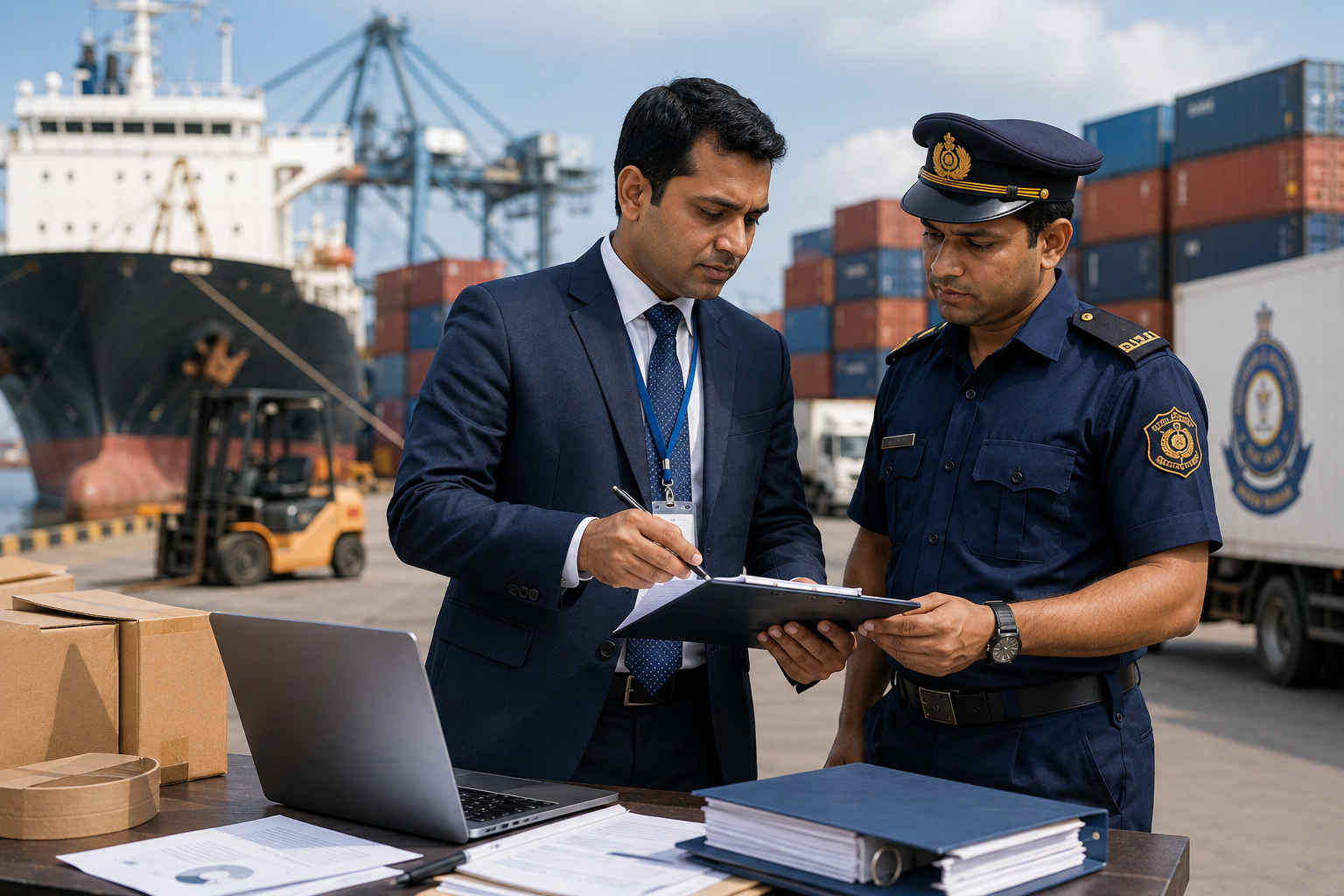
    • Customs Examination Coordination: If customs selects a consignment for physical or first-check examination, the CHA agent coordinates with the examining officer, presents the cargo, and provides supporting documentation.
    • Liaison with Customs Authorities: Managing queries, show-cause notices, and voluntary disclosures — protecting the importer/exporter from procedural errors escalating into penalties.
    • Port & CFS Coordination: Coordinating cargo handling, container stuffing/destuffing, port release, and CFS (Container Freight Station) procedures.
    • DGFT & PGA Compliance: For restricted or regulated goods (pharmaceuticals, food products, chemicals, etc.), obtaining NOCs from Partner Government Agencies (PGAs) such as FSSAI, CDSCO, BIS, and others.

    Advisory Responsibilities

    • Advising on import eligibility and licensing requirements
    • Identifying applicable duty exemptions and FTA benefits (India-ASEAN, India-Japan, India-UAE CEPA, etc.)
    • Advising on AEO (Authorised Economic Operator) certification benefits
    • Flagging regulatory changes that affect your commodity

    Important: Under CBLR 2018, a CHA agent has a legal obligation of due diligence. If they knowingly file incorrect information, they face penalties — but so does the importer/exporter. This means your CHA agent's accuracy and integrity directly affect your legal standing with Indian Customs.

    CHA Agent vs Freight Forwarder vs Clearing Agent: Key Differences

    These terms are often confused. The table below clarifies exactly what each role covers:

    Function CHA Agent Freight Forwarder Clearing & Forwarding (C&F)
    Customs document filing Core function  Not licensed for this (via CHA license)
    Duty payment Manages on client's behalf ?  ?
    Cargo transportation booking Not primary role Core function Often combined
    HS code classification Expert function ?  ?
    Port & CFS coordination  ?  ?  ?
    Regulatory licensing required CBLR 2018 license (IATA accreditation for air) CHA + logistics
    DGFT & PGA coordination  ? ?  ?
    Warehousing (unless integrated) Often offered Often offered

    Arrow Shipping operates as a fully integrated CHA + freight forwarder, meaning you get licensed customs clearance AND logistics under one roof — eliminating handover delays and communication gaps between separate providers.

    Step-by-Step: How a CHA Agent Clears Your Import Shipment

    Understanding the process helps you set realistic timelines and know what to expect at each stage.

    1. Appointment & Authorization

      You appoint the CHA agent by executing a written authorization or Power of Attorney. This is a legal requirement — the CHA cannot act on your behalf without documented authorization.

    2. Document Collection & Review

      The CHA agent collects your commercial invoice, packing list, Bill of Lading / Air Waybill, insurance certificate, and any product-specific certificates. They review for discrepancies that could delay clearance.

    3. HS Code Classification & Duty Calculation

      The CHA classifies goods under the correct ITC-HS code and calculates applicable duties: Basic Customs Duty, IGST, Social Welfare Surcharge, and any anti-dumping or safeguard duties. They also identify any exemptions you qualify for.

    4. Bill of Entry Filing on ICEGATE

      The CHA files your Bill of Entry electronically. The system assigns a bill number and routes it for risk-based assessment — either straight-through (green channel) or for examination.

    5. Assessment & Duty Payment

      Customs officers assess the Bill of Entry. Once finalised, the CHA coordinates duty payment through ICEGATE. For AEO-certified importers, this process is significantly faster through Auto-OOC.

    6. Examination (if Selected)

      If customs selects your shipment for examination, the CHA agent presents the cargo, attends the examination, provides clarifications, and ensures no discrepancy leads to a demand notice.

    7. Out of Charge (OOC) & Cargo Release

      Once duty is paid and examination is cleared, Customs grants Out of Charge. The CHA then coordinates with the port authority or CFS for container release and arranges delivery to your premises.

    Documents Handled by a CHA Agent

    A CHA agent manages a significant volume of documentation across both imports and exports. Here are the critical documents involved:

    Bill of Entry Primary import declaration filed on ICEGATE for every import shipment.

    Shipping Bill Primary export declaration; also the basis for RoDTEP and GST refunds.

    Commercial Invoice Establishes transaction value for customs valuation purposes.

    Packing List Itemised list of cargo contents, weights, and dimensions.

    Bill of Lading / AWB Shipping contract and title document for sea / air cargo respectively.

    Certificate of Origin Establishes country of origin for FTA duty concessions.

    Import Export Code (IEC) Mandatory DGFT-issued code required for all import/export transactions.

    NOC / PGA Certificates FSSAI, CDSCO, BIS, WPC, or other regulatory clearances for restricted goods.

    Test Reports / Lab Analysis For goods subject to BIS or quality control orders at the border.

    Industries That Rely on Licensed CHA Agents in India

    While any importer or exporter needs a CHA agent, certain industries face heightened complexity and therefore rely most heavily on experienced customs professionals:

    Pharmaceuticals & Medical Devices

    Imports require CDSCO registration and drug import licenses. Incorrect handling can result in cargo being destroyed at the port. Arrow Shipping has deep expertise in medical equipment imports and pharmaceutical clearance.

    Automotive & Engineering Components

    HS code classification for auto parts is complex due to overlapping headings. Incorrect classification triggers BIS quality control requirements or anti-dumping duties that significantly inflate landed cost.

    Electronics & Consumer Goods

    BIS mandatory certification under the Electronics and IT Goods Quality Control Orders applies to a growing list of products. A CHA agent ensures compliance before cargo arrives at the port — avoiding costly demurrage while certificates are obtained.

    Industrial Machinery & Capital Goods

    Second-hand machinery imports have specific conditions under DGFT policy. Arrow Shipping handles both new and second-hand machinery imports with full regulatory compliance.

    Textile & Apparel Exports

    Export incentives, RoDTEP benefits, and compliance with buyer country regulations make export CHA services equally important for Chennai's strong textile export sector.

    Common Mistakes When Dealing With a CHA Agent (and How to Avoid Them)

    ?? Watch Out For These:

    1. Choosing on Price Alone

    The cheapest CHA agent is rarely the best choice. A ?2,000 saving on professional fees can cost ?2,00,000 in demand notices, demurrage, or reprocessing. Choose on experience, licensing, and track record.

    2. Not Verifying the CHA License

    Always verify that your CHA agent holds a valid, current CBLR license. Unregistered "agents" may file your documents through a licensed CHA without your knowledge — creating accountability gaps when things go wrong.

    3. Providing Incorrect Invoice Values

    Customs valuation must reflect the actual transaction value. Under-invoicing is a customs offence under the Customs Act, 1962. Your CHA agent will advise you on correct declaration — always follow their guidance.

    4. Not Informing the CHA About Cargo Restrictions

    If your product is on the restricted import list, requires BIS certification, or falls under chemical/dual-use regulations, inform your CHA agent upfront. Discovering this at the port creates costly delays.

    5. Changing CHA Agents Frequently

    A CHA agent who understands your business, commodity mix, and supply chain delivers faster, more accurate clearances over time. Relationship continuity has real commercial value.

    How to Choose the Right CHA Agent in India

    Here is a practical checklist to evaluate any CHA agent before appointing them:

    Evaluation Criteria What to Check Arrow Shipping
    Valid CBLR License Ask for license number; verify with CBIC Licensed & AEO Certified
    Physical Port Presence Office or agent at your port / airport Chennai Seaport & Airport; Delhi
    Commodity Experience Have they handled your product category? All major categories since 1994
    ICEGATE Proficiency All filings must be on ICEGATE — verify capability Fully digital filing
    Transparent Fee Structure Itemised quote: professional fee + port charges + duties Clear, itemised billing
    Integrated Logistics Can they also arrange freight and warehousing? Full freight forwarding & bonded warehousing
    Client References Ask for 2–3 clients in your industry 30+ years of client relationships
    Regulatory Update Communication Do they proactively inform you of customs changes? Regular client advisories

    CHA Agent Charges: What You Should Expect to Pay

    CHA agent charges in India are not standardised by regulation — they are negotiated between the agent and the client. However, understanding the components helps you evaluate any quote fairly.

    Typical Components of a CHA Agent Fee

    • Professional / Agency Fee: The CHA agent's charge for their services — typically ?3,000 to ?15,000+ per shipment depending on complexity, commodity type, and port.
    • Customs Duty: Paid to the government on your behalf. This is your cost — the CHA only manages the payment process.
    • Port / Terminal Handling Charges: Port authority fees for cargo handling — passed through at actuals.
    • CFS Charges: Container Freight Station charges for cargo examination, handling, and storage — charged at actuals.
    • Miscellaneous: Courier charges for document movement, bank charges for duty payment, overtime fees for urgent clearances.

    ? Best Practice: Always request a fully itemised proforma invoice before appointing a CHA agent. Compare like-for-like — professional fees are only one line item. A transparent CHA agent will provide this without hesitation.

    Why Arrow Shipping Is a Trusted CHA Agent in Chennai & Delhi

    Arrow Shipping has operated as a licensed Customs House Agent since 1994 — over three decades of continuous service at Chennai's ports and airport, with representation in Delhi. Here is what that experience translates to for our clients:

    AEO-Certified Partner

    Arrow Shipping holds AEO (Authorised Economic Operator) certification from Indian Customs — one of the highest trust designations available to trade partners. AEO certification means faster clearances, fewer examinations, and priority processing at all Indian ports and airports. As your CHA agent, our AEO status benefits your shipments directly.

    Licensed for All Indian Ports

    While based in Chennai, our customs clearance coverage extends to all major Indian ports and airports — Chennai, Nhava Sheva (Mumbai), Mundra, Delhi Air Cargo, Hyderabad, Bangalore, and more.

    Integrated: CHA + Freight Forwarder + Bonded Warehouse

    Unlike standalone CHA agents, Arrow Shipping offers the complete logistics chain: customs clearance, air and sea freight forwarding, bonded warehousing, and cargo transportation. One contact. Complete accountability.

    Sector Expertise

    We have handled clearances across automotive, pharmaceuticals, electronics, machinery, textiles, raw materials, and project cargo. Our team understands the regulatory nuances specific to each sector — from CDSCO requirements for medical devices to second-hand machinery conditionalities under DGFT.

    What Our Clients Say

    "Arrow Shipping has transformed our logistics operations. Their in-depth knowledge of customs procedures, combined with their proactive and responsive service, has significantly reduced our clearance times."
    — Niranjan B., Braun Mumbai

    "We've trusted Arrow Shipping for over two decades, and they've consistently delivered exceptional results."
    — Shiraz, Mehra Eye Tech (TOPCON Corporation)

    Frequently Asked Questions About CHA Agents in India

    What is a CHA agent in India?

    A CHA agent (Customs House Agent) is a professional licensed by the CBIC under the Customs Brokers Licensing Regulations (CBLR), 2018, authorised to carry out customs clearance of goods on behalf of importers and exporters at Indian ports, airports, and inland container depots. They file Bills of Entry, Shipping Bills, calculate duties, and coordinate cargo release.

    Is appointing a CHA agent mandatory for imports and exports in India?

    For most businesses, yes. While large companies can hold their own customs broker license, the vast majority of Indian importers and exporters must appoint a licensed CHA agent to file customs documentation. Without a licensed CHA, your shipment cannot be cleared through customs.

    What is the difference between a CHA agent and a clearing agent?

    "Clearing agent" is a colloquial term often used to refer to a CHA agent. In regulatory terms, the licensed professional is called a Customs Broker (or CHA). Both terms refer to the same function — a licensed intermediary who manages customs clearance. Some may use "clearing agent" loosely to include unlicensed middlemen, which is why verifying the CBLR license is important.

    Can a CHA agent help with FTA duty benefits?

    Yes — this is one of the most valuable advisory functions a CHA agent provides. India has FTAs with ASEAN, Japan, South Korea, UAE (CEPA), and others. A knowledgeable CHA agent will advise you on whether your goods qualify for preferential duty rates under these agreements and ensure the correct Certificate of Origin is obtained.

    What happens if my CHA agent makes an error in the Bill of Entry?

    Errors in the Bill of Entry can lead to demand notices for differential duty, penalties under the Customs Act, 1962, or even seizure of goods in serious cases. The CHA agent bears professional liability under CBLR for willful errors. However, as the importer, you can also face notices. This is why choosing an experienced, reputable CHA agent is a risk management decision, not just a logistical one.

    How long does customs clearance take with a good CHA agent?

    For AEO-facilitated importers using a compliant CHA agent with accurate documentation, customs clearance can be achieved within 24–48 hours of cargo arrival under Auto-OOC (introduced by CBIC Circular 06/2026). For standard shipments without facilitation, 3–5 working days is typical. Complex cargo with examination or PGA approvals may take longer.

    Does Arrow Shipping handle CHA services for both air and sea cargo?

    Yes. Arrow Shipping is a licensed CHA agent for both air cargo (Chennai International Airport) and sea cargo (Chennai Seaport / Ennore Port), as well as other major Indian ports and airports through our network. We handle both import and export clearances for air and sea shipments.

    What is AEO certification and why does it matter for CHA services?

    Authorised Economic Operator (AEO) certification, issued by Indian Customs, is a trust-based designation given to compliant businesses in the supply chain — including importers, exporters, and customs brokers. An AEO-certified CHA agent like Arrow Shipping benefits from faster processing, priority lanes, and Auto-OOC / Auto-LEO facilities that significantly reduce clearance times for clients.

    Need a Licensed CHA Agent in Chennai or Delhi?

    Arrow Shipping has been clearing cargo across all Indian ports since 1994. AEO-certified. Integrated freight forwarding. One point of contact for your entire import-export logistics chain.

    Get a Free Quote Call +91 91761 81333

    Explore Related Services by Arrow Shipping

    Written by Arrow Shipping – Licensed Customs House Agent Since 1994

    Arrow Shipping is an AEO-certified, government-recognised Customs House Agent with over 30 years of experience in customs clearance, freight forwarding, and logistics across Chennai, Delhi, and all major Indian ports. This article reflects our in-house expertise and is updated to reflect current CBIC regulations and trade practices as of 2026. For personalised advice, contact our team at contact@arrowshipping.in.

  • CHA Customs: How Customs House Agents Navigate Indian Customs System

    CHA Customs: How Customs House Agents Navigate Indian Customs System

    Most importers and exporters know they need a CHA agent — but very few understand how a CHA customs agent actually operates within India's customs system. What happens after documents are submitted? How does risk assessment work? Why does one shipment clear in 24 hours while another sits for five days? This guide answers those questions in full, giving you a practical understanding of how the Indian customs system functions and how an experienced CHA makes it work in your favour.

    What Is CHA Customs and Why It Matters

    The term CHA customs refers to the role a licensed Customs House Agent plays within India's official customs clearance machinery. A CHA agent is not simply a document courier. They are a licensed professional who operates directly inside the Indian customs system — filing declarations, paying duties, coordinating examinations, resolving disputes, and maintaining compliance records on behalf of importers and exporters.

    India's customs administration is governed by the Customs Act, 1962 and administered by the Central Board of Indirect Taxes and Customs (CBIC) under the Ministry of Finance. CBIC oversees all import and export clearance activity at every port, airport, land customs station, and inland container depot in the country.

    CHA agents are governed by the Customs Brokers Licensing Regulations (CBLR), 2018. This regulation defines their obligations, prohibited conduct, licensing requirements, and the penalties for non-compliance. Every licensed CHA is directly accountable to CBIC and must maintain high standards of accuracy and integrity to retain their license.

    Understanding what a CHA customs agent actually does inside this system helps you set realistic expectations, understand why certain steps take time, and choose a CHA agent who genuinely protects your interests.

    ICEGATE: The Digital Platform at the Centre of CHA Customs Work

    ICEGATE — Indian Customs Electronic Gateway — is the national customs portal through which all CHA customs filings are made. For a CHA agent, ICEGATE is the primary work environment. Every Bill of Entry, every Shipping Bill, every duty payment, and every communication with customs officers flows through this platform.

    The platform is integrated with customs offices across India, the GSTN for GST reconciliation, the Reserve Bank of India for foreign exchange reporting, and DGFT for export-import policy compliance. When a CHA customs agent receives your documents, preparing the ICEGATE filing is the first substantive step in the clearance process.

    Bill of Entry Filing

    This is the primary import declaration. The CHA logs onto ICEGATE, enters all shipment details — HS code, declared value, quantity, country of origin, applicable duty exemptions — and submits electronically. The system assigns a Bill of Entry number and the file moves into the risk assessment queue.

    Shipping Bill Filing

    This is the export equivalent. The CHA files it before cargo arrives at the port for examination and loading. The Shipping Bill captures the goods description, declared value, applicable export scheme, and the exporter's compliance status.

    Duty Payment

    After assessment is finalised, the CHA initiates payment through the ICEGATE integrated payment gateway using an authorised bank. Payment confirmation is received electronically and recorded against the Bill of Entry before Out of Charge is granted.

    Status Monitoring and Query Response

    The CHA tracks each Bill of Entry in real time — watching for assessment completion, examination orders, and query notices from customs officers. Any delay in responding to a query holds cargo at the port and accumulates demurrage. An experienced CHA monitors ICEGATE continuously and responds accurately and promptly to every officer communication.

    2026 Update: CBIC Circular 06/2026 expanded Auto-OOC to all compliant importers and introduced e-seal-based Auto Goods Registration for exports. AEO-certified importers and those with clean supply chain histories now benefit from fully system-driven clearances with no manual officer intervention at multiple stages. Arrow Shipping's AEO certification means clients are positioned to benefit from these automation facilities directly.

    Risk-Based Assessment: The Four Customs Channels

    When a CHA files a Bill of Entry, the Risk Management System (RMS) analyses the declaration and assigns it to one of four assessment channels. The channel determines how much examination the cargo undergoes and how quickly it clears customs. This is one of the most important mechanisms in CHA customs practice, and an experienced CHA agent files accurately and consistently to influence channel assignments in the importer's favour.

    Green Channel

    Straight-through clearance with no examination of documents or cargo. Once duty is paid, Out of Charge is issued automatically. This is the fastest possible outcome — clearances can complete within hours of cargo arrival. Green channel assignments go to importers with strong compliance histories, AEO certification, and clean filing records.

    Yellow Channel

    Document verification by a customs officer is required. The officer reviews the Bill of Entry and supporting documents but does not physically inspect the cargo. If documents are complete and consistent, assessment is completed promptly. An experienced CHA ensures documents are prepared to the standard required, making yellow channel processing straightforward.

    Orange Channel

    Both document verification and physical examination of cargo are required. The customs officer checks documents and then inspects the consignment at the Container Freight Station or port examination area. The CHA coordinates the examination appointment, presents the cargo, attends in person, and addresses any discrepancies found immediately at the examination itself.

    Red Channel

    Intensive physical and document examination. Reserved for high-risk shipments, commodities flagged by customs intelligence, or consignments with complex compliance requirements. The examination is thorough and the CHA must attend throughout — managing the process and ensuring that minor discrepancies do not escalate into formal show-cause notices.

    What Determines the Channel Assignment

    The importer's compliance history is the single most influential factor. A clean, consistent record with no past discrepancies consistently results in more green and yellow clearances over time. Commodity risk also matters — chemicals, electronics, pharmaceuticals, and agricultural products carry higher examination risk regardless of the importer's individual record. Country of origin risk, declared value patterns, and AEO certification all contribute to the RMS decision for each consignment.

    How Arrow Shipping Helps: Our 30-year track record of accurate, consistent ICEGATE filings means that clients who import regularly through us build a positive compliance profile recognised by the RMS. Combined with our AEO certification, this consistently results in faster channel assignments and fewer examination delays across our clients' shipments.

    Import Customs Clearance: The Complete CHA Process

    The following steps cover the full import clearance sequence managed by a CHA customs agent from document receipt to cargo delivery.

    1. Pre-Arrival Document Review The CHA collects the commercial invoice, packing list, Bill of Lading or Air Waybill, and any product certificates before cargo arrives at port. Reviewing documents in advance catches discrepancies and allows corrections before filing — preventing avoidable delays once the shipment is at port.
    2. HS Code Classification and Duty Calculation The CHA classifies goods under the correct ITC-HS code from the Customs Tariff Act. This determines every duty applicable: Basic Customs Duty, Integrated GST, Social Welfare Surcharge, and any anti-dumping or safeguard duties. Incorrect classification is the most common cause of customs demand notices and post-clearance audit findings.
    3. Bill of Entry Filing on ICEGATE The CHA files the Bill of Entry electronically, selecting the correct type — Home Consumption for standard clearance, Into Bond for bonded warehousing, or Ex-Bond for clearance from a bonded warehouse. The RMS assigns a channel and the assessment process begins.
    4. Assessment and Query Management The customs officer assesses the Bill of Entry according to the assigned channel. The CHA monitors ICEGATE continuously and responds to any officer queries promptly. Delayed or incomplete responses stall the file and extend clearance time.
    5. Cargo Examination Coordination If examination is ordered under orange or red channel, the CHA coordinates with the CFS or port to schedule the examination. The CHA attends in person, presents cargo, provides all required documentation to the examining officer, and records the examination report. Discrepancies are addressed on the spot before they become formal findings.
    6. Duty Payment Once assessment is finalised, the CHA initiates payment through the ICEGATE payment gateway. The duty challan is generated electronically and payment confirmation is recorded before proceeding to cargo release.
    7. Out of Charge and Cargo Delivery With duty paid and no pending compliance requirements, the system grants Out of Charge. The CHA coordinates with the port authority or CFS for container release and arranges delivery to the importer's premises or bonded warehouse as required.

    Export Customs Clearance: The CHA's Role

    Export clearance follows a parallel process with different documents and distinct regulatory touchpoints. The CHA customs agent's role on the export side is equally critical to preventing delays and protecting the exporter's incentive entitlements.

    Shipping Bill Filing

    The Shipping Bill is the primary export declaration. The CHA files it on ICEGATE before cargo arrives at the port or airport. The type filed depends on the applicable export scheme — a Free Shipping Bill for standard exports, a Drawback Shipping Bill where duty drawback is claimed, or a Bill filed under other incentive notifications.

    Goods Registration and Let Export Order

    After cargo arrives at the port and is registered, customs grants the Let Export Order (LEO) — the formal authorisation to load cargo. The CHA manages all pre-LEO activities including documentation verification and examination coordination. With the Auto-LEO facility introduced in 2026, LEO is now granted automatically for Shipping Bills not selected for examination, significantly reducing export processing time for compliant exporters.

    RoDTEP Compliance

    The CHA ensures the Shipping Bill correctly declares the applicable RoDTEP (Remission of Duties and Taxes on Export Products) scheme rate. Incorrect or missing declarations result in denial of export benefits, directly affecting the exporter's cost structure. The CHA ensures RoDTEP credits are correctly linked to the Shipping Bill so they flow automatically to the exporter's account on ICEGATE.

    GST Refund on Exports

    Exporters who export under Letter of Undertaking are entitled to IGST refund. The CHA ensures the Shipping Bill and the exporter's GST returns are correctly matched through the GSTN-ICEGATE integration. Mismatches between the two systems are a common cause of refund delays and the CHA's role is to prevent them at the point of filing.

    The Indian Customs Duty Structure: What the CHA Calculates

    Accurate duty calculation is one of the most technically demanding aspects of CHA customs work. The duty structure for imports involves several components applied in a specific sequence, each on a different base value.

    Duty Component Applied On Notes
    Basic Customs Duty (BCD) Assessable Value (CIF plus 1% landing charge) Rate varies by HS code. Commonly 5% to 20% for most goods. Can exceed 100% for certain sensitive products.
    Social Welfare Surcharge (SWS) BCD amount 10% of BCD. Not levied if BCD is nil or fully exempted.
    Integrated GST (IGST) Assessable Value plus BCD plus SWS Mirrors the domestic GST rate: 5%, 12%, 18%, or 28%. Claimable as Input Tax Credit by GST-registered importers.
    Anti-Dumping Duty (ADD) Assessable Value or per unit depending on notification Levied on specific goods from specific countries where dumping is established by DGTR. Must be verified per HS code and country of origin before every filing.
    Safeguard Duty Assessable Value Temporary duty to protect domestic industry. Commodity-specific and time-bound.
    Countervailing Duty (CVD) Assessable Value plus BCD plus SWS Levied on subsidised imports from specific countries where DGTR establishes material injury to domestic industry.
    Compensation Cess Assessable Value plus all duties above Applicable on select goods such as tobacco products, automobiles, and certain luxury items.

    Important for Importers: Getting the HS code wrong by even one sub-heading can change the BCD rate, trigger anti-dumping duty, or attract mandatory BIS certification requirements that were not planned for. A skilled CHA customs agent classifies correctly at the point of filing — protecting you from post-clearance audit demands that can arrive months or years after shipment.

    Partner Government Agencies: The Hidden Complexity in CHA Customs

    For many product categories, customs clearance requires more than paying duty and receiving Out of Charge. Partner Government Agencies have regulatory oversight over specific goods and their approval is a mandatory prerequisite for customs release. Cargo cannot be cleared without it, no matter how accurately the Bill of Entry is filed.

    This is one area where inexperienced CHA agents cause the most costly delays — by failing to identify PGA requirements before shipment arrival, leaving importers with cargo accumulating demurrage at port while approvals are chased under time pressure.

    Regulatory Agency Product Categories Approval Required
    FSSAI Food products, food additives, nutraceuticals, beverages No Objection Certificate or Import Clearance Certificate
    CDSCO Pharmaceuticals, medical devices, cosmetics Drug Import License, Registration Certificate, NOC for samples
    BIS Electronics, electrical goods, toys, cement, steel products Mandatory BIS certification or test report conformance under quality control orders
    WPC — DOTD Wireless equipment, radio devices, telecom products Equipment Type Approval Certificate
    Plant Quarantine Seeds, plants, fresh produce, agricultural goods Phytosanitary certificate from origin plus import permit from NPPO India
    Animal Quarantine Animal products, veterinary biologicals, animal feed Sanitary Import Permit plus veterinary health certificate from origin
    AERB Radiation-emitting equipment, nuclear materials Atomic Energy Regulatory Board clearance
    PESO Explosives, petroleum equipment, gas cylinders Petroleum and Explosives Safety Organisation permit

    Arrow Shipping advises clients on PGA requirements before shipments are dispatched from the country of origin. This pre-shipment advisory ensures that every mandatory certificate and approval is in place before cargo arrives at Indian ports — eliminating the costly situation of cargo sitting at port while approvals are obtained under demurrage pressure.

    AEO Certification and Its Effect on CHA Customs Clearance

    The Authorised Economic Operator (AEO) programme is India's trusted trader framework. It recognises importers, exporters, logistics providers, and CHA agents who demonstrate consistent compliance, financial soundness, and supply chain security. AEO certification is issued by CBIC in three tiers for importers and exporters.

    AEO-T1 is the entry-level tier. Benefits include faster document assessment, priority examination scheduling, and easier access to customs officers for query resolution.

    AEO-T2 provides enhanced benefits including Auto-OOC eligibility, Direct Port Delivery priority, and dedicated customs assistance for complex clearances.

    AEO-T3 is the highest tier, providing the lowest examination frequency of any importer category, expedited processing across all Indian ports, and direct relationships with senior customs officers for dispute resolution.

    CHA agents can hold AEO-LO (Logistics Operator) certification. Arrow Shipping is AEO-certified, which means every client shipment carries the credibility of a trusted, government-recognised customs broker. Customs officers give greater confidence to filings from AEO-certified CHAs, resulting in faster assessments, fewer unnecessary queries, and smoother clearances. For clients who are not yet AEO-certified themselves, working with an AEO-certified CHA is the most direct way to begin benefiting from the RMS trust framework while building their own compliance history.

    Customs Disputes: How a CHA Customs Agent Protects Your Interests

    Even with accurate filings, customs disputes can arise — particularly around valuation, classification, or examination findings. An experienced CHA customs agent is your first line of defence when challenges arise.

    Show-Cause Notice

    If customs believes there has been a duty short-payment, a misdeclaration, or a compliance breach, they issue a Show-Cause Notice. The CHA drafts the written reply, assembles supporting evidence, and represents the importer at the personal hearing before the adjudicating officer. The quality of the reply directly determines the outcome of the adjudication.

    Provisional Assessment

    When the correct duty cannot be determined at the time of clearance — for example when a final price is subject to a post-shipment adjustment — the CHA can request provisional assessment. Cargo is released upon payment of provisional duty and execution of a bond. The CHA monitors and finalises the assessment when correct information is available.

    Customs Valuation Disputes

    Customs officers can reject a declared transaction value and substitute a higher value based on comparable import data. The CHA argues the case with documentary evidence — contracts, price lists, related-party pricing disclosures, and market data — to defend the declared value and prevent unjustified duty demands.

    The Appeals Process

    If an adjudication order goes against the importer, the CHA guides the client through the formal appeals hierarchy. The Commissioner (Appeals) is the first level. Larger disputes proceed to the CESTAT — Customs, Excise and Service Tax Appellate Tribunal. For significant legal questions, cases can proceed to the High Court and ultimately the Supreme Court of India.

    Post-Clearance Audit: Why CHA Compliance Records Matter Long After Clearance

    Many importers assume that once cargo is released and Out of Charge is granted, all customs liability is resolved. This is a costly misconception.

    Under the Customs Act, 1962, the CBIC's Audit Commissionerate conducts post-clearance audits of importers' records, reviewing past transactions to verify that correct duties were paid, correct exemptions were claimed, and correct classifications and values were declared. These audits can cover up to five years of past transactions.

    A CHA customs agent with disciplined compliance practices provides several layers of protection. Complete records of every Bill of Entry, examination report, duty payment challan, and customs correspondence must be maintained for the full statutory period. Consistent HS code classification across all shipments of the same product builds a defensible record — inconsistency is one of the first patterns that audit officers identify.

    Where duty exemptions are claimed under FTA certificates of origin, EPCG scheme, EOU benefits, or other notifications, the CHA ensures all underlying eligibility documents are obtained, verified, and archived at the time of import. Claiming an exemption without the correct supporting documentation can result in a full duty demand plus interest in a post-clearance audit, even years after the original clearance.

    If an error is discovered internally after clearance, a proactive CHA can file for voluntary payment of differential duty before an audit detects it. Voluntary compliance significantly reduces penalty exposure and is always preferable to being found in default during a formal audit.

    Audit Risk: Post-clearance audit demand notices can reach crores of rupees for businesses that have been making systematic classification or valuation errors across multiple shipments. The cost of a professional, experienced CHA customs agent is a fraction of a single audit demand. Accuracy at the point of filing is not just operational best practice — it is essential financial protection for your business.

    Why Choose Arrow Shipping as Your CHA Customs Agent

    Arrow Shipping has operated as a licensed Customs House Agent since 1994. Over three decades, we have managed customs clearances across every major commodity category — pharmaceuticals, automotive components, electronics, industrial machinery, medical equipment, textiles, food products, and raw materials — at Chennai, Delhi, and all major Indian ports and airports.

    Our AEO certification reflects our standing within the Indian customs system: a trusted, compliant, and consistently accurate customs broker. This status benefits clients directly through faster RMS channel assignments, Auto-OOC eligibility, and priority examination scheduling when examination is unavoidable.

    We operate as an integrated service provider — combining licensed CHA customs clearance with air and sea freight forwarding, custom bonded warehousing, and cargo transportation under one roof. This eliminates the coordination gaps that arise when customs clearance and logistics are handled by separate providers, and gives clients a single point of accountability for their entire import or export transaction.

    Our team advises clients on PGA requirements before shipments are dispatched, identifies applicable duty exemptions and FTA benefits, and monitors regulatory changes affecting specific commodity categories. When disputes arise, we represent clients with the authority and documentation that comes from 30 years of direct customs experience.

    Frequently Asked Questions

    What is CHA in customs?

    CHA in customs stands for Customs House Agent. It is a professional licensed under the Customs Brokers Licensing Regulations (CBLR), 2018 by CBIC to file import and export documents, pay duties, and represent importers and exporters before Indian customs authorities at all ports, airports, and inland container depots across India.

    What is ICEGATE and how does a CHA use it?

    ICEGATE is the Indian Customs Electronic Gateway — the national customs portal operated by CBIC. A CHA agent uses ICEGATE to file Bills of Entry and Shipping Bills, pay duties electronically, monitor assessment status, respond to customs queries, and access examination orders and OOC or LEO confirmations. All CHA customs filings in India are made through ICEGATE.

    What are the four customs channels in India?

    India's Risk Management System assigns Bills of Entry to four channels: Green for straight-through clearance with no examination, Yellow for document verification only, Orange for document check plus physical examination, and Red for intensive physical and document examination. The channel determines the speed and complexity of the clearance process for each shipment.

    What is Out of Charge in customs?

    Out of Charge (OOC) is the formal customs order that authorises release of imported goods after all applicable duties are paid and any examination is completed. The port authority cannot release cargo to the importer without an OOC order on record. With the 2026 Auto-OOC facility, eligible importers now receive OOC automatically without manual officer intervention.

    Can a CHA agent challenge a customs duty demand?

    Yes. When customs issues a differential duty demand through a Show-Cause Notice, the CHA drafts the written response, presents documentary evidence, and represents the importer at the personal hearing. If the adjudication order is unfavourable, the CHA guides the appeal through the Commissioner (Appeals), CESTAT, and if necessary the High Court or Supreme Court.

    What is a post-clearance audit?

    Post-clearance audit is a CBIC process in which past import transactions are reviewed for compliance, typically covering up to five years. Auditors verify that correct duties were paid, correct exemptions were claimed, and correct classifications and values were declared. A professional CHA agent protects importers through complete record maintenance, consistent classification, and proactive correction of any errors before they are discovered in an audit.

    How does AEO certification help in CHA customs clearance?

    AEO certification gives trusted importers and their CHA agents priority treatment in the customs system — more green channel clearances, eligibility for Auto-OOC, fewer examinations, and faster dispute resolution. Arrow Shipping is AEO-certified, meaning clients benefit from our trusted trader status through faster, smoother clearances across all Indian ports and airports.

    Work With a CHA Customs Agent Who Knows the System Inside Out

    Arrow Shipping has operated as a licensed, AEO-certified Customs House Agent since 1994. We manage the full customs process from ICEGATE filing and duty calculation to examination coordination, PGA approvals, and post-clearance compliance. Chennai and Delhi operations, coverage across all Indian ports.

    Get a Free Quote Call +91 91761 81333

    Related Services and Resources

    Written by Arrow Shipping — Licensed Customs House Agent Since 1994

    Arrow Shipping is an AEO-certified, government-recognised Customs House Agent with over 30 years of hands-on experience in CHA customs operations across Chennai, Delhi, and all major Indian ports and airports. This guide reflects our operational expertise and is updated to reflect CBIC regulations, ICEGATE systems, and trade policy as of 2026. For expert guidance on your specific import or export requirement, contact us at contact@arrowshipping.in or call +91 91761 81333.
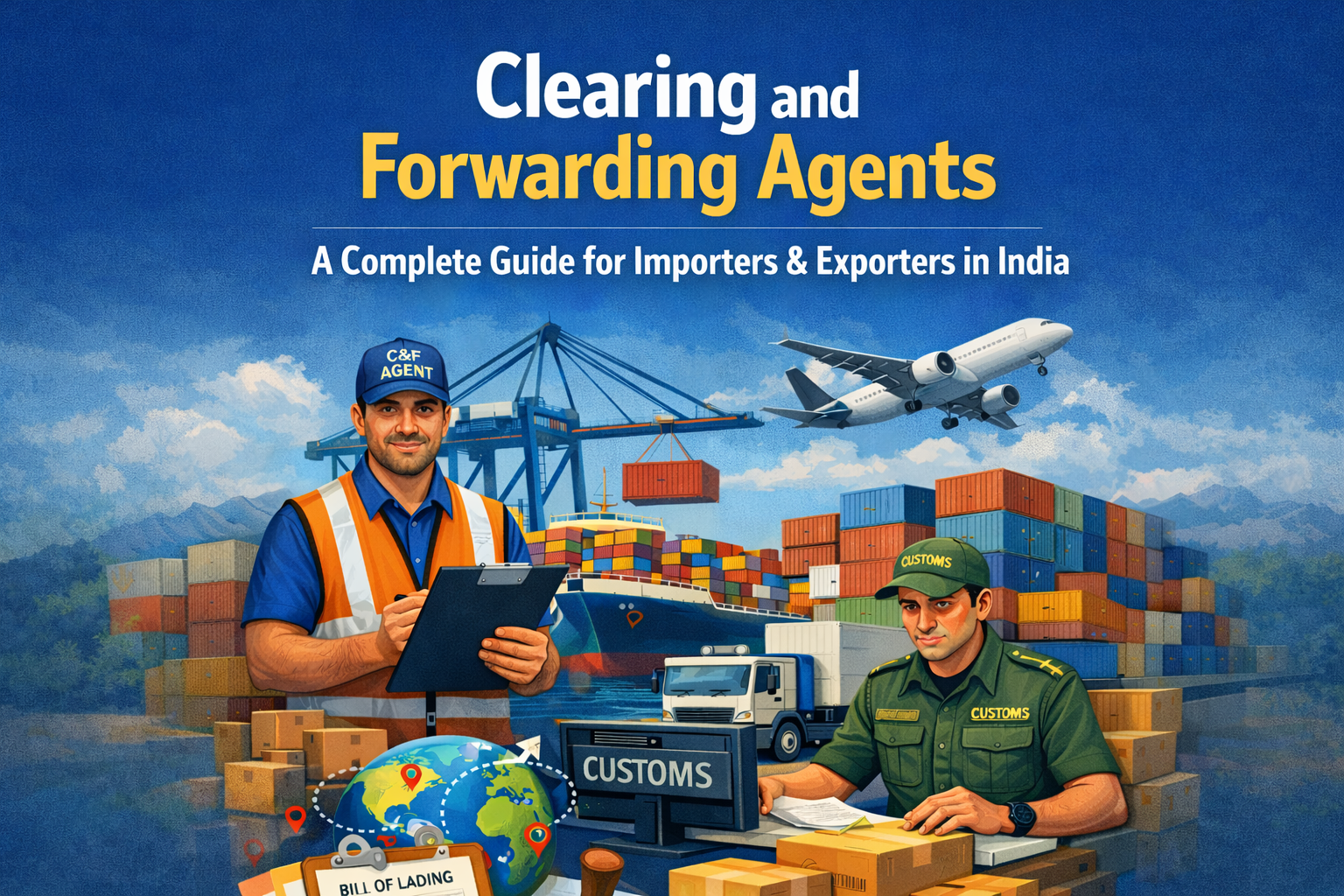
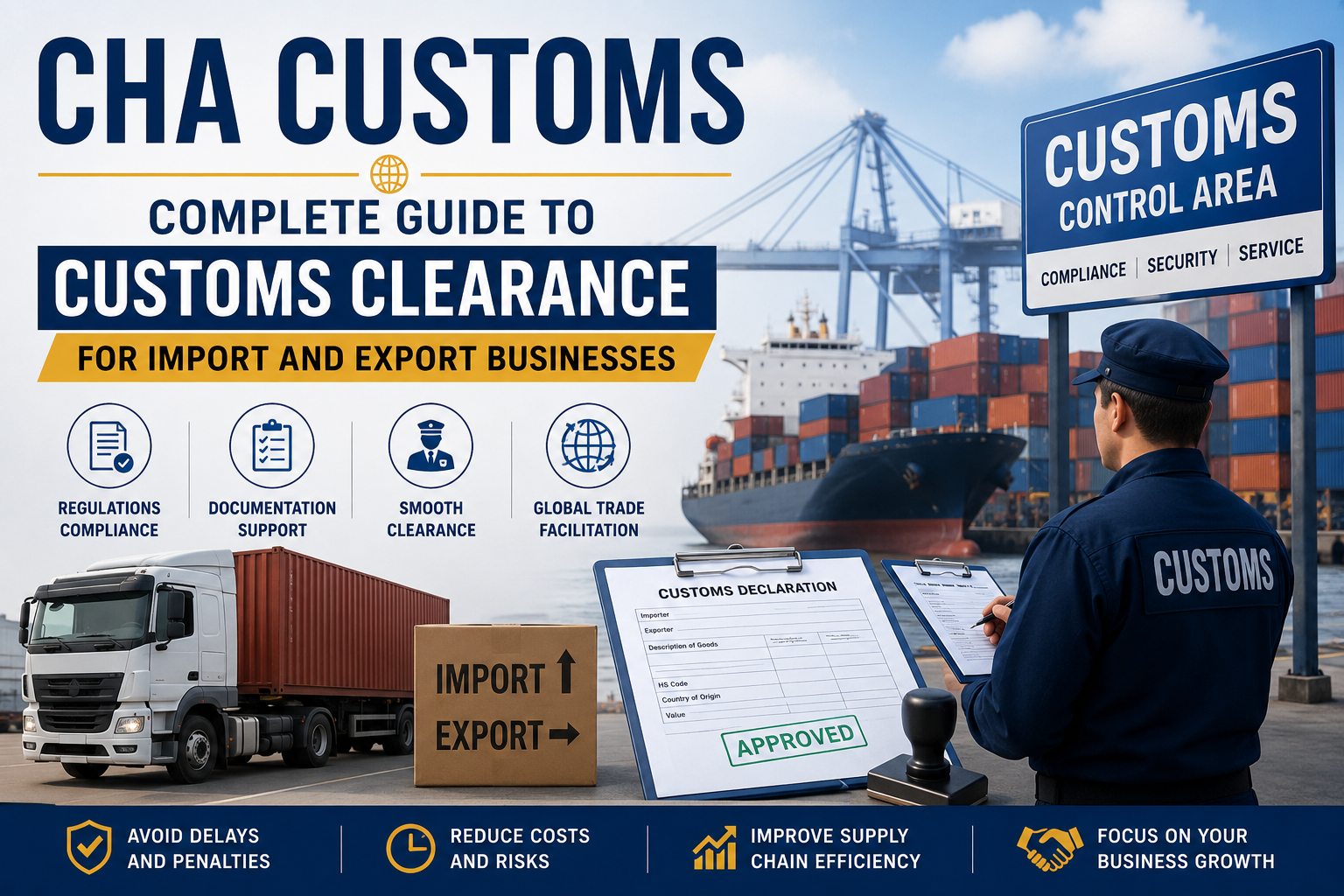
  • Custom Bonded Warehouse in India: Complete Guide for Importers (2026)

    Custom Bonded Warehouse in India: Complete Guide for Importers (2026)


    A custom bonded warehouse lets you import goods into India and defer customs duty payment until you actually need the stock. Goods can be stored for up to 3 years, withdrawn in partial quantities, or re-exported without paying any Indian duty. For importers who buy in bulk, manage seasonal demand, or use India as a distribution hub, bonded warehousing delivers significant cash flow and logistics advantages.

    Paying full customs duty the moment a container arrives — before you even need the goods — locks up working capital unnecessarily. For businesses that import in bulk, manage seasonal production cycles, or serve multiple markets from a single stock point, this is a real cost problem.

    A custom bonded warehouse solves it. Instead of paying duty at the port, you move your goods into licensed bonded storage and pay duty only when you withdraw stock for actual use. The rest stays in the warehouse — duty-free, secure, and ready when you need it.

    This guide covers everything about bonded warehousing in India: how it's licensed, how the import process works, what you can and can't store, and the specific cash flow and logistics advantages it offers.

    What is a custom bonded warehouse in India? A custom bonded warehouse is a government-licensed storage facility where imported goods are held under customs bond without immediate duty payment. Duty is deferred until goods are withdrawn for home consumption. Licensing is governed by Sections 57–58 of the Customs Act 1962, and the facility operates under CBIC supervision. Goods can be stored for up to 3 years and can be re-exported without incurring Indian customs duty.

    Bonded Warehousing in India — Key Facts & Figures 2026

    Parameter Detail Reference
    Maximum storage period 3 years from date of import Customs Act 1962
    Duty payment timing At Ex-Bond clearance only CBIC
    Partial withdrawal allowed Yes — pay duty on quantity withdrawn Customs Act 1962
    Re-export without duty Allowed from bonded warehouse CBIC
    Licensing authority CBIC — Section 57 (public) / 58 (private) Customs Act 1962
    India warehousing market size 2025 USD 35+ billion DPIIT Industry Report 2025
    Chennai Port container throughput 2 million+ TEUs/year Chennai Port Authority
    Duty rate applicable Rate on date of Ex-Bond clearance Customs Act 1962
    Arrow Shipping warehouse location Near Chennai seaport & airport Arrow Shipping
    Arrow Shipping experience 30+ years since 1994 Arrow Shipping

    What Is a Custom Bonded Warehouse?

    A custom bonded warehouse is a storage facility licensed by CBIC where imported goods are held under a customs bond. The bond is a legal guarantee that duty will be paid when goods leave the warehouse for home consumption. Until that point, the goods stay in storage — under customs control but without duty liability on the importer.

    Two types of bonded warehouses exist under Indian law. Section 57 warehouses are public facilities run by government agencies. Section 58 warehouses are privately owned and licensed — these are the type most importers use when working with a logistics provider like Arrow Shipping.

    The warehouse itself operates under strict CBIC oversight. Every movement of goods — in or out — is documented and reported to customs. The importer can withdraw stock in any quantity at any time, paying duty only on what is taken out.

    How Bonded Warehousing Works — The Full Import Process

    Using a bonded warehouse doesn't complicate your import. It adds one step at the front and changes when duty is paid. Here's how the full process works:

    Step 1: File an Into-Bond Bill of Entry

    When your cargo arrives at the Indian port, your CHA files an Into-Bond Bill of Entry on ICEGATE instead of a standard import Bill of Entry. This declares the goods for bonded storage rather than home consumption. Customs assesses the applicable duty but does not collect it at this stage. The assessment is recorded for future reference.

    Step 2: Transfer Cargo to the Bonded Warehouse

    After customs approves the Into-Bond filing, the cargo moves from the port to the licensed bonded warehouse — under customs supervision. The transfer is documented, and the goods are now officially in bonded storage. Port-related charges stop accruing. Demurrage risk disappears.

    Step 3: Store and Manage Inventory

    Your goods sit in the bonded facility, secure and accounted for. You can withdraw as much or as little as you need — 10 units today, another 50 next month — paying duty only on what you take. The rest continues to wait in bonded storage, duty-free.

    Step 4: File an Ex-Bond Bill of Entry When You Need Stock

    When you're ready to use the goods, your CHA files an Ex-Bond Bill of Entry. Duty is calculated at the rate applicable on the withdrawal date — not the original import date. This matters if duty rates change during the storage period. Payment clears the goods for home consumption.

    Step 5: Delivery to Your Factory or Distribution Centre

    After customs releases the goods, they're transported from the bonded warehouse to your facility. Arrow Shipping handles this end-to-end — from port pickup to bonded storage to final delivery, with all customs documentation managed in-house.

    Quick answer — Can you withdraw partial stock from a bonded warehouse? Yes. You pay duty only on the quantity you withdraw each time. The rest stays in bonded storage until you need it. This makes bonded warehousing ideal for businesses with variable production or sales schedules.

    Key Benefits of Custom Bonded Warehousing

    1. Duty Deferment — Better Cash Flow

    This is the headline benefit. You don't pay duty until you use the goods. If you import a 3-month supply at once, you only pay duty on what you clear each month — not all of it upfront. For high-duty goods, this can free up substantial working capital.

    2. Re-Export Without Duty

    If your plans change — a foreign buyer comes through, or you want to redirect stock to another market — you can re-export directly from the bonded warehouse without paying Indian customs duty at all. This makes bonded storage valuable for traders who import speculatively or who serve multiple markets.

    3. Reduced Port Congestion Risk

    Moving goods out of the port quickly and into bonded storage eliminates demurrage exposure. You're not racing the clock to clear customs before port charges escalate. The cargo is safe in the warehouse while you manage clearance at your own pace.

    4. Flexible Inventory Management

    Withdraw what you need, when you need it. Bonded warehousing lets you import in bulk — capturing better freight rates and supplier pricing — while releasing stock in smaller, demand-driven quantities.

    5. Consolidation from Multiple Shipments

    You can bond goods from multiple different import shipments in the same facility, building a consolidated inventory base. This is especially useful for manufacturers who import components from several suppliers globally.

    Feature Bonded Warehouse Regular Warehouse
    Duty payment timing On withdrawal only At import clearance
    Re-export without duty Yes No (duty already paid)
    CBIC supervision Yes — licensed facility No
    Partial withdrawal Yes — duty on quantity No restriction
    Max storage period 3 years Unlimited
    Cash flow benefit Significant — duty deferred None

    Which industries benefit most from bonded warehousing? Manufacturers importing components or raw materials, electronics importers, automotive parts suppliers, pharma companies importing APIs, and traders who re-export goods to third-country buyers all see strong cash flow and logistics benefits from bonded storage.

    What Can Be Stored in a Bonded Warehouse?

    Most commercial import goods are eligible for bonded storage. This includes raw materials, components, machinery, electronics, textiles, industrial equipment, and consumer goods. The key requirement is that the goods must be declared under a valid Bill of Entry and must comply with all applicable import regulations.

    Certain categories require additional consideration. Hazardous goods need special approvals and may require dedicated bonded facilities with appropriate safety infrastructure. Perishable goods with short shelf lives are generally not suited to extended bonded storage. Restricted imports — such as certain chemicals, dual-use goods, or controlled substances — require valid licences before storage and clearance.

    Important — Duty Rate Risk: Duty is calculated at the rate applicable on the Ex-Bond date, not the original import date. If duty rates increase during your storage period, you pay the higher rate when you withdraw stock. Your CHA can advise on duty rate trends and optimal withdrawal timing for your commodity.

    Arrow Shipping's Bonded Warehouse — Chennai

    Arrow Shipping's custom bonded warehouse is located near Chennai's seaport and airport — putting your stock minutes from the port, not hours. Our facility is CBIC-licensed under Section 58 of the Customs Act 1962 and handles both FCL and LCL cargo.

    As an AEO-certified company, we combine bonded storage with integrated customs clearance, freight handling, and cargo transportation under one roof. You don't need to coordinate between three separate service providers — we manage the full chain from port to warehouse to factory.

    10-Point Bonded Warehouse Readiness Checklist

    • ? Confirmed goods are eligible for bonded storage (not perishable or prohibited)
    • ? Import licence or permit obtained for regulated commodities
    • ? CHA appointed with experience in Into-Bond and Ex-Bond filing
    • ? CBIC-licensed bonded facility identified near your port of entry
    • ? Into-Bond Bill of Entry filed before cargo is released from port
    • ? Storage duration planned to stay within 3-year limit
    • ? Inventory management system in place for partial withdrawal tracking
    • ? Duty rate monitoring in place for commodity during storage period
    • ? Re-export documentation prepared if redirection to foreign buyer is possible
    • ? Transportation plan from bonded warehouse to factory confirmed

    Frequently Asked Questions — Custom Bonded Warehouse India

    What is a custom bonded warehouse in India?

    A custom bonded warehouse is a CBIC-licensed facility where imported goods are stored under customs bond without immediate duty payment. Duty is deferred until goods are withdrawn for home consumption. Goods can be stored for up to 3 years and can be re-exported duty-free. The facility operates under Sections 57–58 of the Customs Act 1962.

    How long can goods be stored in a bonded warehouse in India?

    Goods can be stored in an Indian bonded warehouse for up to 3 years from the date of import. After 3 years, the goods must be cleared for home consumption by paying applicable duties, re-exported, or abandoned to customs. Extensions beyond 3 years require CBIC approval and are not routinely granted.

    What is the benefit of using a bonded warehouse?

    The primary benefit is duty deferment — you pay customs duty only when you actually withdraw stock for use. This improves cash flow significantly for bulk importers. Other benefits include the ability to re-export without paying Indian duty, partial stock withdrawal, and reduced demurrage exposure by moving cargo off the port quickly into bonded storage.

    Can goods be re-exported from a bonded warehouse without paying duty?

    Yes. Goods can be re-exported from an Indian bonded warehouse to another country without paying customs duty. This is one of the key advantages for traders who import speculatively or who serve multiple markets. The re-export must be declared and documented through ICEGATE before the goods are moved out of the bonded facility.

    What is the difference between a bonded and a regular warehouse?

    A bonded warehouse holds goods under customs control, with duty deferred until withdrawal. A regular warehouse stores goods that have already cleared customs and had duty paid. Bonded storage allows re-export without duty; regular storage does not. Bonded warehouses require CBIC licensing and operate under customs supervision.

    How does Arrow Shipping manage bonded warehouse operations?

    Arrow Shipping manages the complete bonded warehouse cycle — port pickup, Into-Bond filing, secure storage near Chennai port, Ex-Bond clearance, and final delivery. As an AEO-certified logistics company with 30+ years of experience, we combine bonded warehousing with integrated customs clearance and cargo transportation, handling everything under one roof.

    Related Resources

  • Clearing House Agent: Complete Guide for Import and Export Customs Clearance

    Clearing House Agent: Complete Guide for Import and Export Customs Clearance

    International trade involves complex customs regulations, documentation requirements, and compliance procedures. Businesses importing or exporting goods must ensure that their shipments meet all regulatory requirements before cargo can be released. This is where a clearing house agent plays a critical role.

    A clearing house agent manages customs clearance processes on behalf of importers and exporters. From documentation preparation to duty calculation and coordination with customs authorities, these professionals ensure smooth cargo movement. Choosing an experienced clearing house agent helps businesses avoid delays, penalties, and operational disruptions.

    With decades of expertise in customs clearance and logistics, Arrow Shipping provides professional clearing house agent services for seamless import and export operations.

    What Is a Clearing House Agent?

    A clearing house agent is a licensed professional responsible for handling customs clearance procedures for import and export shipments. They act as intermediaries between businesses and customs authorities.

    Their primary objective is to ensure that goods comply with customs regulations and are cleared efficiently.

    Key Responsibilities

    • Preparation of import and export documentation
    • Filing Bills of Entry and Shipping Bills
    • Duty calculation and assessment
    • Coordination with customs authorities
    • Cargo examination handling
    • Clearance and release of goods

    Clearing house agents simplify complex customs procedures.

    Importance of a Clearing House Agent in International Trade

    Ensures Regulatory Compliance

    Customs regulations require accurate documentation and declarations. Clearing house agents ensure compliance with applicable laws.

    Reduces Clearance Delays

    Professional handling speeds up cargo clearance and avoids demurrage charges.

    Minimizes Risk

    Incorrect classification or documentation can result in penalties. Clearing house agents help prevent errors.

    Simplifies Logistics Coordination

    They act as a single point of contact between customs, ports, and logistics providers.

    Import Clearance Services by Clearing House Agent

    Import clearance involves multiple steps and documentation.

    Import Services Include

    • Bill of Entry filing
    • Duty assessment
    • Cargo examination coordination
    • Customs release
    • Delivery planning

    Arrow Shipping ensures smooth import clearance operations.

    Export Clearance Services

    Export shipments require proper documentation and regulatory compliance.

    Export Services Include

    • Shipping bill preparation
    • Export documentation verification
    • Customs clearance coordination
    • Cargo movement to port or airport

    These services ensure timely shipment dispatch.

    Clearing House Agent for Air Cargo

    Air cargo shipments require fast processing and documentation accuracy.

    Clearing house agents handle:

    • Air import clearance
    • Air export clearance
    • Airline coordination
    • Airport customs processing

    Arrow Shipping ensures quick air cargo clearance.

    Clearing House Agent for Sea Cargo

    Sea cargo involves containerized and bulk shipments.

    Services include:

    • FCL clearance
    • LCL clearance
    • Port coordination
    • Container release

    Professional handling ensures efficient sea cargo clearance.

    Documents Handled by Clearing House Agents

    Accurate documentation is critical.

    Common documents include:

    • Commercial invoice
    • Packing list
    • Bill of lading
    • Air waybill
    • Bill of entry
    • Shipping bill
    • Certificate of origin

    Arrow Shipping ensures proper documentation.

    Industries That Use Clearing House Agent Services

    Clearing house agents support various industries:

    • Manufacturing
    • Automotive
    • Electronics
    • Pharmaceuticals
    • Textile exports
    • Engineering goods

    Arrow Shipping provides industry-specific solutions.

    Challenges in Customs Clearance

    Documentation Errors

    Incorrect documents delay shipments.

    Regulatory Changes

    Frequent policy updates require expert knowledge.

    Cargo Examination Delays

    Proper coordination speeds up inspections.

    Duty Calculation Issues

    Correct classification prevents disputes.

    Clearing house agents resolve these challenges.

    Why Choose Arrow Shipping as Clearing House Agent

    Experienced Customs Professionals

    Arrow Shipping has decades of customs clearance experience.

    Licensed CHA Services

    Authorized to handle import export clearance.

    End-to-End Logistics Support

    Freight forwarding and customs clearance under one roof.

    Strategic Locations

    Operations in Chennai and Delhi.

    Clearing House Agent vs Freight Forwarder

    Clearing House Agent

    • Focus on customs clearance
    • Handles documentation
    • Ensures regulatory compliance

    Freight Forwarder

    • Handles transportation
    • Coordinates carriers
    • Manages cargo movement

    Arrow Shipping provides both services.

    Clearing House Agent Process

    Step-by-step process:

    1. Document collection
    2. Customs filing
    3. Duty calculation
    4. Cargo examination
    5. Clearance approval
    6. Cargo release
    7. Delivery coordination

    Arrow Shipping manages each stage.

    Choosing the Right Clearing House Agent

    Consider:

    • Experience in customs clearance
    • Licensing and compliance
    • Industry expertise
    • Service coverage
    • Transparent communication

    Arrow Shipping meets these requirements.

    Future of Clearing House Agent Services

    With digitization of customs procedures and growing trade volumes, clearing house agents play an increasingly important role. Businesses require faster clearances and compliance support.

    Professional agents help streamline global trade.

    Conclusion

    A professional clearing house agent is essential for smooth import and export operations. From documentation to customs clearance and cargo release, expert handling ensures compliance and efficiency.

    With decades of experience, Arrow Shipping provides reliable clearing house agent services for businesses engaged in international trade.